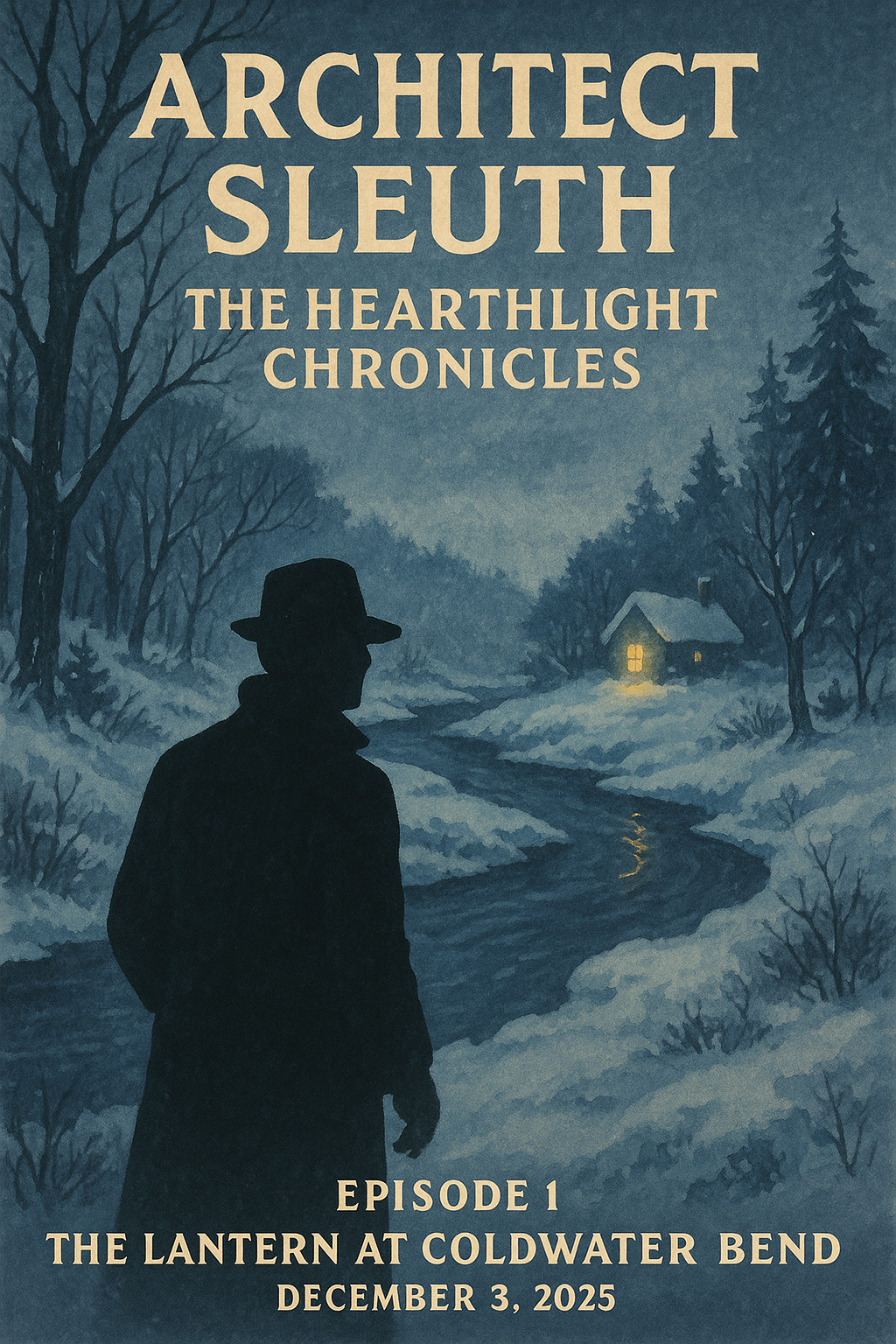
“The Lantern at Coldwater Bend”
December 3, 2025 – Episode 1 of the December Holiday Arc
[Soft orchestral music fades in: a slow, warm melody over gentle strings. We hear the faint crackle of a fireplace, and the distant whistle of a winter wind.]
ANNOUNCER (rich, vintage tone):
From the quiet hills and winding river roads of a town that time forgot, we bring you once again the adventures of Wallace Granger — retired architect, reluctant detective, and keeper of curious stories along the coast and countryside.
Tonight, as December settles over the fields like a quilt of frost, a small community prepares for its most cherished winter tradition… only to discover that someone has taken the light that leads them home.
So, gather close to the radio, draw another log upon the fire, and listen as we open a new chapter in…
ARCHITECT SLEUTH
“The Lantern at Coldwater Bend”
[Music swells, then gently fades beneath the narrator’s voice.]
SCENE 1 – THE ROAD TO WILLOWMEAD
[Sound: The steady hum of an old truck engine, the soft whump of tires over packed snow, and a quiet heater fan hissing. Occasionally, a bit of sleet ticks at the windshield.]
NARRATOR:
Winter was early that year. Not the wild, howling sort of winter that threw branches across the back roads and turned power lines into jump ropes of ice… no. This was a quieter winter. The kind that arrived on tiptoe in late November and decided to stay, leaving a thin powder of snow over farm fields and silencing the world just enough to make you listen.
Wallace Granger, retired architect, sometime sleuth, sat behind the wheel of his faithful pickup, coaxing it along the winding route from his home on the bluff down toward the low valley town of Willowmead. He’d driven this road many times before in autumn, when the trees burned gold… but December painted them differently. Their bare branches reached skyward like ink strokes on gray paper.
On the seat beside him, a rolled-up set of sketching paper slid a little with every turn.
[Sound: The rustle of paper; a thermos cap gently unscrewed.]
WALLACE (mild, thoughtful, a bit wry):
Well now, if the mayor says it’s “a small matter,” that usually means it’s anything but.
NARRATOR:
He was speaking more to the steam rising from his coffee than to any passenger. That morning, just as he’d settled into his drafting chair with the idea of sharpening three pencils and doing absolutely nothing of consequence, the telephone had rung.
SCENE 2 – EARLIER THAT MORNING, WALLACE’S STUDY
[Sound: Phone ringing in a quiet house. Somewhere, a kettle hums on low.]
NARRATOR:
Wallace’s study never quite looked retired. Rolls of plans leaned in corners like half-finished thoughts, models of houses perched on shelves, and a pair of reading glasses forever seemed to roam from desk to windowsill to drafting table of their own accord.
He answered the phone on the second ring.
[Click of receiver.]
WALLACE:
Granger residence.
MAYOR HOMESTEAD (voice on phone, warm, slightly harried):
Wallace? Wallace Granger?
WALLACE:
At your service, Mayor Homestead… though I should warn you, my services before breakfast are limited.
MAYOR:
You have coffee, I hope. This may require clear thinking.
WALLACE:
I’m working on the coffee. Clear thinking’s negotiable.
What seems to be the trouble?
MAYOR:
It’s Willowmead, Mr. Granger. We… well, we’ve had something go missing. And not just anything. The council thought — we all thought — perhaps you could come down and have a look before word spreads.
WALLACE:
Missing, you say. Livestock, ledger, or reputation?
MAYOR (a brief, strained chuckle):
I wish it were livestock. We’ve lost The First Light.
WALLACE (a small pause, searching memory):
The First Light…?
NARRATOR:
Wallace leaned back, squinting at the wooden beams of his ceiling, sifting through the attic of his memory. Then, it came to him: a photograph he’d once seen in a newspaper — a slender, hand-carved lantern lifted above a crowd beside a dark river.
WALLACE:
You mean the lantern you use for the Hearthlight Festival down there? The old one?
MAYOR:
The very one. The original. Crafted by Eli Willow himself, or at least that’s the story. It’s… gone, Wallace. Vanished right out of the town hall display case.
WALLACE:
And I imagine it didn’t just get up and walk out after a century behind glass.
MAYOR:
If it did, it’s got better knees than I have.
Look, Wallace — the festival’s in less than two weeks. Folks are already putting candles in jars, hanging wreaths on every doorway. The First Light is the heart of it all. If word gets out that it’s missing—
WALLACE:
—there’ll be more gossip in Willowmead than snowflakes.
MAYOR:
Exactly. I’d… rather not bring the county sheriff in just yet. This could be nothing more than a misunderstanding. But… the case glass was smashed.
WALLACE (quietly):
Ah. Glass was smashed. That does suggest more than misplacing the centerpiece.
All right, Mayor. Put on a pot of something hot. I’ll be down within the hour.
BACK TO THE ROAD
[Sound: Return to the truck interior, engine hum, faint heater hiss.]
NARRATOR:
And so, Wallace drove. Past the old stone bridge at Coldwater Bend, where the river knifed between frosted reeds. The locals said the bend got its name from a December long ago, when a wagon plunged through thin ice and the driver came out shivering but alive, shouting that the water was “cold enough to wake the dead.”
Wallace slowed as he crossed the bridge, glancing at the river’s surface.
[Sound: The truck transitions over a small bridge, tires on planks, the gentle whisper of river below.]
WALLACE (softly, to himself):
Hearthlight Festival… First Light lantern… and someone with a reason to steal it.
Well now. Let’s see what kind of winter mischief you’ve brewed up down here.
SCENE 3 – WILLOWMEAD TOWN HALL
[Sound: Door opening with a creak, followed by the low hum of a small-but-busy building — muffled voices, a distant typewriter clacking, and coats being shaken free of snow at the entrance.]
NARRATOR:
Willowmead’s town hall was the kind of building that had been renovated just enough to confuse it. Once a simple brick rectangle with tall windows and a bell over the entry, it now sported a glassed-in vestibule, a semi-modern reception counter, and a tangle of bulletin boards advertising everything from Christmas bake sales to a lost tabby cat named Nutmeg.
Mayor Homestead met Wallace halfway across the lobby, his wool coat already open, tie slightly askew.
MAYOR:
Wallace! Good to see you. Come on in, come on in — wipe your boots or Mabel will have both our hides.
WALLACE:
I’d like to keep what’s left of mine. Good morning, Mayor.
NARRATOR:
They shook hands, and Wallace’s experienced eyes made a slow sweep of the lobby. He could see, off to the right, a set of double doors propped open. Beyond them, faintly, came the tinkling of glass being swept into a pan.
MAYOR (following his gaze):
That’s the festival hall. We usually hold the opening ceremony in there before we take the lantern to the river. That display case has been in the same spot since… well, before my time.
Come on. Let me show you.
[Footsteps on scuffed hardwood, light echo; the sound of sweeping becomes clearer.]
NARRATOR:
Inside the hall, a row of windows let in pale winter light, catching on dust and decorations still in progress: garlands waiting to be hung, folded paper stars, and a plywood platform being repainted for the children’s choir. Near the back wall stood an empty pedestal, and beside it, a janitor on his hands and knees, scraping glass from the floor.
MAYOR:
Harvey, take a break, would you? I want Mr. Granger to be able to see the mess properly.
HARVEY (older, gravelly but good-natured):
Morning, Mr. Mayor. Morning, sir. Always nice when the highlight of my day is sweeping up the town’s history.
WALLACE (with a small smile):
Some history’s worth sweeping carefully, Harvey.
NARRATOR:
The display case itself lay in ruin: a wooden frame, its front panel entirely shattered and fallen inward. Shards of glass that hadn’t yet been collected glittered around the base like ice. On the pedestal, a rectangle of dust marked where the lantern had once rested, the absence sharp and clear as a missing tooth.
WALLACE:
No lantern in sight, I see. When was it last here?
MAYOR:
Two nights ago. We had a small committee gathering here — early festival planning. Afterward, I locked up myself. Mabel, at the front desk, saw it yesterday afternoon when she came in. But this morning… well, Harvey came in first to shovel the front steps and—
HARVEY:
And I near dove out of my boots when I saw the glass, sir. Nothing else touched so far as I can tell. Just the case.
WALLACE:
Locks on the building?
MAYOR:
Still locked when Harvey arrived. No windows broken. No sign of forced entry.
WALLACE:
So whoever it was either had a key… or knew someone who did.
NARRATOR:
Wallace stepped closer, his mind measuring angles as naturally as breathing. The height of the pedestal. The thickness of the glass. Tiny concentric cracks spread outward from a point somewhere about a third of the way up.
He crouched, careful not to disturb the debris line.
[Sound: Wallace kneels; a quiet clink as he nudges a piece of glass with a gloved finger.]
WALLACE:
Interesting.
MAYOR:
What do you see?
WALLACE:
Impact came from the outside, angled low to high. Possibly a heavy object swung upward — a hammer, crowbar, maybe even the base of a lantern pole. The glass fell inward, as you’d expect…
But look here.
NARRATOR:
He pointed to a faint streak on the pedestal’s dust outline, where something had scraped through.
WALLACE:
The lantern was pulled toward this side. The thief reached in, dragged it out quickly. Some dust disturbed, but not flattened the way it would be if they’d set something in its place.
No attempt to hide the absence. They wanted it gone, not disguised.
MAYOR (uneasy):
So… deliberate, then.
WALLACE:
Very.
Harvey, did you notice anything unusual outside when you came in? Footprints? Tire marks?
HARVEY:
Just the usual mess from yesterday’s comings and goings. Snow was too trampled to tell much by this morning. But there was something odd out on the side path… a whiff of something… wasn’t sure if my nose was playing tricks.
WALLACE:
A whiff of what?
HARVEY (thinking):
Like… pine pitch, maybe. And peppermint. Both at once. Thought it was some new cleaning nonsense Mabel ordered.
MAYOR:
We don’t have any pine-peppermint cleaners, Harvey.
HARVEY:
Then I reckon it wasn’t cleaning supplies, sir.
NARRATOR:
Wallace filed that away. Pine pitch and peppermint. An odd pairing, but not random. He’d noticed many trades came with their own scents — painters’ turpentine, masons’ dust, lumbermen’s sap and sawdust. Some mixtures told stories long before the people involved ever spoke.
SCENE 4 – OUTSIDE THE HALL, THE SIDE PATH
[Sound: Door opens to chilly air, wind lightly gusting, snow crunching underfoot.]
NARRATOR:
Mayor Homestead led Wallace around the corner of the building to a narrow side path. It connected the town hall’s rear door to a small parking lot and an alley that ran between the bakery and the post office.
The snow here was patchier, trodden down by deliveries and townsfolk going about their business. But in certain pockets, where the wind had been kind, a crust of undisturbed white lay like blank paper.
Wallace knelt again, scanning.
WALLACE:
You shovel this path each morning, Harvey?
HARVEY:
Yes sir. Did it yesterday after the flurries. No fresh snow overnight, though, just a little drift.
NARRATOR:
Wallace’s eyes narrowed on one particular patch by the wall. The snow there bore faint impressions — nothing so crisp as a detective might hope for, but enough for someone who’d spent a lifetime reading patterns in materials and terrain.
WALLACE:
Here. Someone stood against this wall. Maybe more than once. See how the snow is compressed deeper along this line?
MAYOR:
It just looks like a smudge to me.
WALLACE:
Smudges are stories with poor handwriting, Mayor.
They leaned, perhaps listening for someone to open the back door… or watching for who came and went from the hall.
NARRATOR:
He followed the faint depressions away from the building, toward the alley. There, the tracks were lost in a muddle of footprints and tire ruts. Still, something caught him — a small dark speck.
[Sound: Wallace pinches up a tiny object from the snow.]
WALLACE:
Well now…
MAYOR:
What is it?
WALLACE:
Looks like… a bit of thread. Red… no, not thread. Ribbon. Torn from something.
NARRATOR:
He turned it between his fingers. It was narrow, satin-like, frayed on one end. In his mind he pictured the old lantern: brass frame, glass panes, and along its top handle… yes, that was it. The last time he’d seen a photograph, there had been a narrow red ribbon tied in a bow near the handle, dangling alongside a string of tiny tin charms.
WALLACE:
I suspect this belonged to the First Light.
MAYOR (grim):
So it got this far, at least. Out the back and into town.
WALLACE:
Possibly. Or whoever took it brushed against it, tore this loose before they made their way out.
Mayor… tell me about the lantern. Beyond the usual festival tradition. Any particular family attached to its care? Any old grievances, arguments about its use?
MAYOR (sighs):
In a small town, Wallace, everything has some argument attached to it, if you go back far enough.
But yes, I suppose you could say the lantern has… a following. Historians love it. Romantic types swear it’s brought people back home after long years away. We parade it through the streets, then carry it down to where the willow trees lean over the river at Coldwater Bend. There, we light the first candle for the season.
They say it’s guided more than one lost soul back to Willowmead.
WALLACE (quiet):
Guided lost souls…
And what do you suppose someone gains by taking it now?
MAYOR:
That’s what I can’t fathom. You can’t sell the thing — everyone for fifty miles around would recognize it. It’s too valuable to us to disappear quietly.
WALLACE:
Sometimes, Mayor, people don’t steal to gain. They steal to reclaim. Or to say something no one’s listened to in a very long time.
SCENE 5 – MABEL’S DESK & A CHILD’S MITTEN
[Sound: Back through the hall, more footsteps, then the cozy bustle of the town hall front desk area. Papers rustle; someone stamps a document.]
NARRATOR:
Back at the front desk, Mabel Carter — who had indeed insisted boots be wiped — waited with a logbook in hand. She was a small woman with a neatly coiled bun and a gaze that could pin a notice to the bulletin board without the aid of thumbtacks.
MABEL:
Mayor, I hope you haven’t let Harvey scatter glass all through my hallway.
MAYOR:
We’ve kept it contained, Mabel. Mr. Granger here needs to know what you saw yesterday.
MABEL:
What I saw, or what I didn’t see? Because I can tell you, I didn’t see anyone marching out of here with a lantern under their arm.
WALLACE (smiling politely):
Morning, Ms. Carter. Anything you noticed could help. I’m especially interested in yesterday afternoon — who came and went, anything unusual, that sort of thing.
NARRATOR:
Mabel pursed her lips, then consulted her logbook.
MABEL:
Let’s see… Yesterday. We had:
— Mrs. Langley, in at nine, fussing about the choir robes;
— Two delivery fellows from the hardware store dropping off extra lights;
— Old Mr. Harper, here to volunteer his services as “official historian” again;
— Clara—
WALLACE:
Clara?
MABEL:
Yes, that new young woman renting the room above the bakery. Came in asking to see the festival program, said she wanted to “understand how the town celebrates in winter.” Sweet thing, but she had that look of someone carrying ten years of questions in her pockets.
MAYOR:
Did she go into the hall, Mabel?
MABEL:
Not that I saw. I gave her the pamphlet right here. She asked about the First Light, of course — everybody does, first time.
WALLACE:
And what did you tell her?
MABEL:
That it was right where it always is. In the case at the back of the hall.
NARRATOR:
Wallace considered that. A newcomer, asking about a very old tradition. It wasn’t enough to point blame, but it scratched at some corner of the larger picture he couldn’t yet see.
As he thought, Mabel set her logbook down and reached into a drawer.
MABEL:
There is something else, Mayor — almost forgot. I found this near the front door when I opened up this morning.
[Sound: A soft thump as she sets an object on the counter.]
NARRATOR:
Wallace looked down. It was a small knitted mitten, pale blue with a little white snowflake pattern. The sort of thing a child might wear.
WALLACE:
Any children here yesterday, Mabel?
MABEL:
Not a one. And before you ask, I don’t recognize it from anyone in town. Most of the kids have bright wool mittens — handmade by Mrs. Kirsch at the craft shop. This one… looks store-bought.
MAYOR:
Could someone have dropped it passing by?
MABEL:
Right on the mat where you’d step in? I doubt it. That lobby was swept just before closing yesterday. This wasn’t there then, or I’d have picked it up.
NARRATOR:
Wallace picked up the mitten, turned it over gently.
On the inside cuff, faintly, were two stitched letters: C. C.
WALLACE:
C.C. Could be initials. Or perhaps a store brand. Does Willowmead have any family with those initials?
MABEL:
Not that leap to mind. But I’ll ask around.
WALLACE:
Please do. Children tend to leave clues wherever they go. Sometimes they do it on purpose.
SCENE 6 – LUNCH AT THE RIVERSIDE DINER
[Sound: The soft clink of cutlery, low murmur of diners, a diner bell rings as the door opens from time to time.]
NARRATOR:
By midday, snow began to fall again — fine as sifted flour, swirling along the riverbank. Wallace and Mayor Homestead took refuge in the Riverside Diner, a long, narrow establishment where the windows fogged in winter and the coffee never seemed to run out.
They took a booth near the back.
MAYOR (sighing):
I appreciate you coming down, Wallace. I know this isn’t exactly glamorous detective work.
WALLACE:
I retired from glamorous long ago, Mayor. These days, I’m more interested in… honest puzzles.
MAYOR:
So, what do you make of it? Could this just be some teenage prank?
WALLACE:
Maybe. Teenagers are capable of nearly anything when they’re bored and unsupervised. But most pranks carry a certain… flair. Overturned displays, graffiti, maybe the lantern would’ve been found hanging from the flagpole by now.
This is quiet. Purposeful. Someone broke the glass, took only the lantern, and left. No broken chairs, no extra damage, no message scrawled on the wall.
MAYOR:
And the child’s mitten? The ribbon?
WALLACE:
Those are threads. We have two for now: a mysterious child, and someone who knows precisely what the First Light means.
NARRATOR:
The waitress topped off their cups. Outside, through the fogged glass, Wallace could see the river beyond the road. Even from here he knew where it would bend, where the willow trees leaned over and the festival lanterns would one day soon line its edge.
WALLACE:
Tell me more about the festival itself. Start at the beginning. The very beginning.
MAYOR:
You mean the story they tell children, or the story the historians argue about?
WALLACE:
Both. Let’s start with the children’s story. They usually remember the important parts.
MAYOR (settling in, voice taking on a storyteller’s rhythm):
All right. Once upon a time — that’s how Mrs. Kirsch always starts it at the library — Willowmead was just a handful of houses huddled near the river. Winters were hard. Folks were scattered on farms, roads weren’t what they are now. Sometimes, family didn’t make it home before the snows came in.
So, the founder — Eli Willow — carved a lantern. A special one. He said he’d hang it by the river at the first snow every winter, so anyone still on the road could find their way by its light.
The children say the lantern glowed brighter when someone needed it.
WALLACE:
And the historians?
MAYOR:
They say Eli carved the lantern as a memorial. They say he had a daughter who left one winter and never came back. Some say she married and moved away, some whisper darker endings. Either way, the lantern became a tradition. A symbol of welcoming home anyone who’d been gone too long.
WALLACE (softly):
Welcoming home the lost.
MAYOR:
That’s why people get so sentimental about it. We carry it through town every year. Folks touch it for luck, or whisper a name they hope will return. Soldiers, estranged cousins, old friends.
WALLACE:
Then our thief… if thief is the right word… might be someone with a name on their lips. Someone who’s been waiting for a long time.
SCENE 7 – TWILIGHT AT COLDWATER BEND
[Sound: Evening wind, river lapping, the occasional creak of tree branches.]
NARRATOR:
By late afternoon, the snowfall had ceased, leaving the world muffled and still. The Mayor had been called away to some council matter, leaving Wallace with a set of borrowed keys and the freedom to walk.
He parked near Coldwater Bend, pulling his scarf tighter as he stepped out into the crisp air. The river flowed dark and steady, its edges crusted with ice. Willow trees along the bank bowed under the weight of snow, their long branches trailing like pale curtains.
This was where the Hearthlight Festival would open, in just a couple of weeks. Lanterns would stand along the path — homemade jars with candles, painted tins, wreath-lit posts — all leading to the central spot where The First Light would flicker above the crowd.
WALLACE (to himself):
If you were taken… where would you want to go?
NARRATOR:
He walked the path slowly, boots crunching through thin snow. Here and there, he saw the beginnings of preparation — a wooden post erected in the ground, a pile of bundled string lights, a stack of straw bales waiting for the evening fires.
Near the bend of the river proper, he stopped.
[Sound: His steps cease; just river and faint wind.]
NARRATOR:
Someone else had been here, and not long ago. The snow bore the marks: footprints, smaller than his own, with a short stride. Next to them, a deeper set, heavier — perhaps an adult. The tracks wandered up from the path and down toward the water, then back again.
There, pressed into the snow next to a willow trunk, was the imprint of a small form that had sat down — or perhaps curled up for a moment, knees drawn up.
Beside it… something else.
WALLACE:
Hello there.
NARRATOR:
He knelt to pick up a small paper object, wax-splotched and creased. It was a handfolded lantern — the kind children make at school, colored with crayon. A house, windows glowing yellow. Above it, a small circle. And over that, a five-pointed star.
The same shape repeated three times.
WALLACE (murmuring):
A house… a circle… a star.
NARRATOR:
He turned the lantern gently. On one flap, written in clumsy block letters:
“FOR WHEN WE COME HOME.”
Below that, the same stitched initials he’d seen in the mitten, but written in pencil this time.
“C. C.”
WALLACE:
C.C. again. You’ve been busy.
NARRATOR:
He followed the tracks as best he could, but they grew muddled where the path met the parking area. Still, one thing he noticed as he walked back to his truck: here and there, on the bark of the willow trees, someone had scratched a simple shape.
A house. A small circle above it. A star above that.
SCENE 8 – EVENING IN THE TOWN LIBRARY
[Sound: Door chime; the quiet hush of a small library — pages turning, a distant clock ticking.]
NARRATOR:
With the winter sky darkening and the first evening lights flickering on in shop windows, Wallace made one more stop before heading home. Willowmead’s library was a modest brick building, warmed by radiators and the determined spirit of the town’s librarian, Mrs. Kirsch.
He found her at the returns desk, sorting a stack of children’s books about snowmen and reindeer.
MRS. KIRSCH (kind, slightly breathless):
Mr. Granger! Oh, I’ve heard you were in town. Investigating our little… unpleasantness.
WALLACE:
I’m just asking questions at the moment, Mrs. Kirsch. Speaking of which, I have one for you.
Do you know any child — or perhaps family — with the initials C.C.? Small child, blue mitten, fond of drawing houses and stars?
MRS. KIRSCH (thinking):
C.C… well, we’ve got the Cuthberts, but their boy is Harlan, if you can believe it. The Chapmans have a little girl, but she’s an L.S., for Lily. No C.C. that I can think of on my library card list.
Although… now that you mention it…
NARRATOR:
She shuffled through a stack of recent sign-up forms, then plucked one free.
MRS. KIRSCH:
Here. New patron form from about a week ago. A young woman — Clara Carthage. She asked if we had any local histories about Willowmead, particularly about the river and the early families.
WALLACE:
Carthage. C.C.
MRS. KIRSCH:
That’s right. Though I suppose those initials could belong to her, not a child. She seemed a bit… untethered. Like someone trying to fit themselves into a story they’d only half-heard.
WALLACE:
Did she mention why she was so interested?
MRS. KIRSCH:
Not directly. But she did ask if we had any records of a family — Carthage, like her — living anywhere near the river, or “connected to the lanterns,” as she put it. I told her she might have better luck with old Mr. Harper, our resident historian.
WALLACE:
Harper was at the hall yesterday as well.
MRS. KIRSCH:
Then chances are she’s spoken to him by now.
NARRATOR:
Wallace nodded, tucking that information away. Carthage. New to town, old family name perhaps, drawn to the lantern and the river’s history like a moth to a flame.
Before he left, Mrs. Kirsch stopped him with another tidbit.
MRS. KIRSCH:
Oh, and Mr. Granger? Clara asked about one other thing.
WALLACE:
What was that?
MRS. KIRSCH:
She asked if anyone had ever gone… missing… connected to the Hearthlight Festival. Not in the legend, but in real records.
NARRATOR:
Wallace’s brows rose.
WALLACE:
And what did you tell her?
MRS. KIRSCH:
I told her officially? No. The festival’s always been a happy thing here.
Unofficially… well… there are always whispers. Long-lost relatives. People who didn’t make it back before the snow.
I told her if she wanted ghosts, she should talk to Harper. He likes those better than I do.
SCENE 9 – NIGHT DRIVE HOME
[Sound: Truck engine again; wipers rhythmically clearing the windshield. A bit of distant radio static, then faint old-time music humming low.]
NARRATOR:
Night fell swift and early. Wallace’s truck made its familiar climb back toward the bluff, headlights cutting a narrow tunnel through the dark. Snowflakes drifted lazily across the beams like dust motes in a long hallway.
On the seat beside him lay the small paper lantern from the riverbank, its folded sides soft and fragile.
A house. A circle. A star. “For when we come home.”
WALLACE (musing aloud):
Clara Carthage, asking about vanished families and lantern legends. A child’s mitten with the same initials. And a stolen symbol of welcome for the lost.
Who are you looking for, C.C.? And what do you think the First Light owes you?
NARRATOR:
As he turned onto the stretch of road near Coldwater Bend again, Wallace slowed instinctively. There was a clearing there — a place where the trees pulled back from the road, giving a wider view of the river.
Tonight, something else caught his eye.
NARRATOR (leaning in):
There, far off by the water’s edge, a faint, flickering glow moved behind the willows. Not a car. Not a house light. It bobbed gently, up and down, as if someone were walking, lantern in hand.
WALLACE (quietly, focused):
Well now… that’s not on any festival schedule.
[Sound: Truck engine idling down as he pulls off the road; gravel crunching. Engine shuts off, leaving the hush of winter night and the soft hiss of the river.]
NARRATOR:
He stepped out, the cold air biting at his cheeks, and listened. Somewhere, carried on the breeze, he thought he heard it — a tune. Faint, halting. The kind of melody you might hum without thinking, something half-remembered from childhood.
A lullaby.
WALLACE (calling softly):
Hello there! Along the river!
NARRATOR:
The light paused. For a heartbeat, it flared brighter, as if startled. Then, as quickly as a match being pinched out, it vanished.
The music, if it had ever been real, went with it.
Wallace stood in the dark, eyes adjusting, breath steaming before him.
WALLACE (to himself):
Lanterns, children’s drawings, old family names, and ghosts who haven’t decided if they’re real yet.
All right, C.C. Whoever you are, you’ve got my attention.
EPILOGUE – BACK AT THE STUDY
[Sound: Crackling fire in a hearth; clock ticking; a pen scratching lightly on paper.]
NARRATOR:
Later that night, at home in his study, Wallace spread out what he had gathered: the red ribbon scrap, the blue mitten, the folded paper lantern. He drew a small diagram the way he would for a renovation, lines and notes connecting each small clue.
He wrote three words in the margin:
WHO TOOK IT?
WHY NOW?
COMING HOME?
Outside, the wind brushed against the window panes, carrying with it the faint scent of snow and far-off woodsmoke.
NARRATOR (softly):
Somewhere out there, a lantern that had guided souls home for a century was burning for someone new. Whether it was in anger, longing, or hope, Wallace Granger did not yet know.
But he would.
Because in a town like Willowmead, where stories settle deep into the winter earth, secrets can’t stay buried forever. Not when the lights begin to rise by the river.
[Music gently swells — the warm orchestral theme from the beginning, now richer, tinged with a hint of mystery.]
ANNOUNCER:
You’ve been listening to Architect Sleuth, starring Wallace Granger in tonight’s episode, “The Lantern at Coldwater Bend.”
Join us next week as Wallace’s investigation leads him into the shadowed paths of Willowmead Woods, where the echoes of the past carve strange symbols among the trees… in our next episode:
“The Echoes in Willowmead Woods.”
Until then, keep a light in your window…
and a good story in your heart.
[Music rises, then fades out. End of episode.]
Leave a Reply