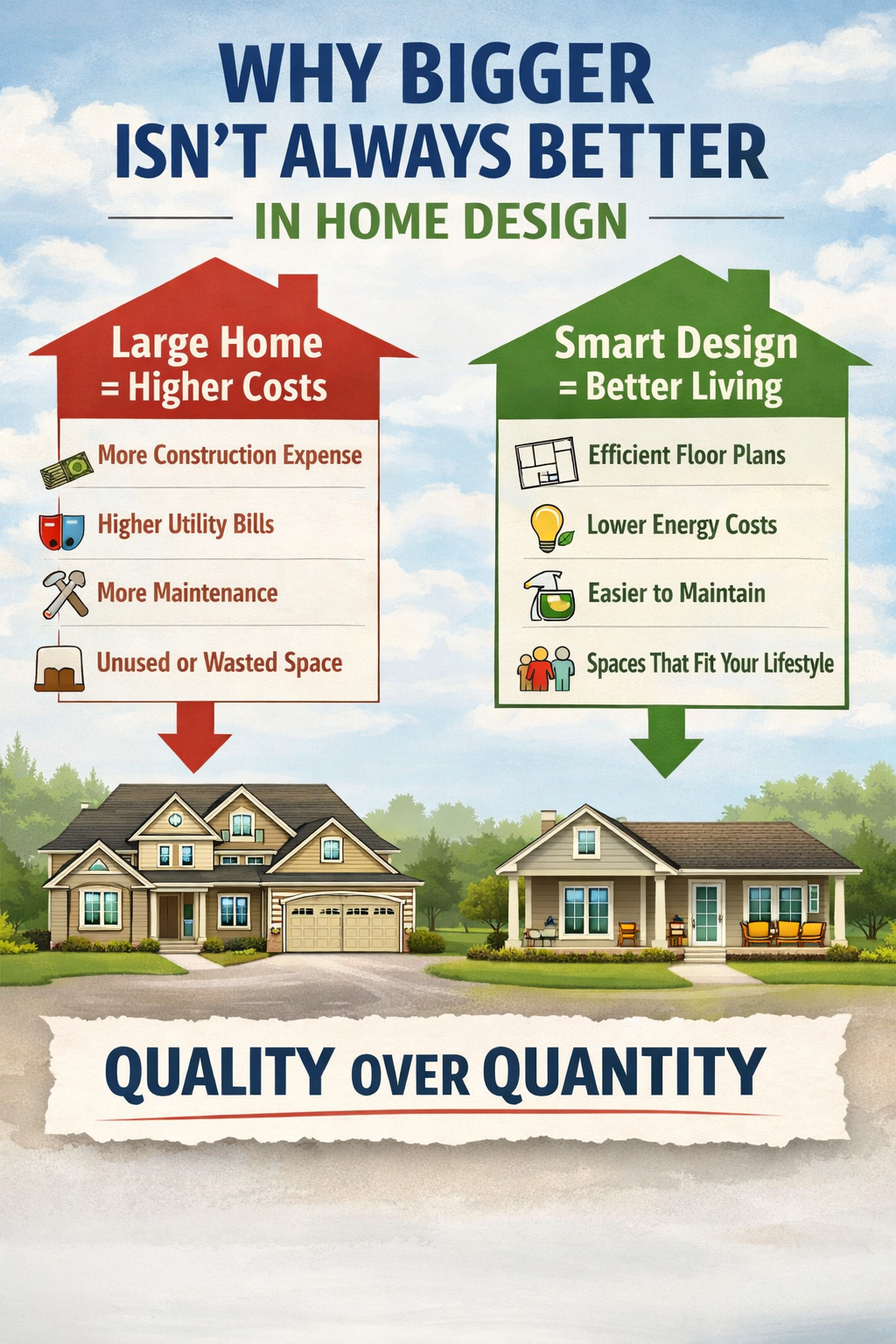
When many homeowners begin planning a custom home, one of the first questions that arises is, “How big should it be?”
It is easy to assume that a larger home automatically means a better home. After all, more square footage sounds appealing. More rooms, more storage, and more space for everyday life can seem like obvious advantages.
However, one of the most important lessons in residential design is this:
A well-designed home is not defined by its size—it is defined by how well the space works.
In fact, thoughtful design often proves that efficiency, layout, and intentional planning can outperform sheer square footage. Many homes that appear large on paper do not actually function better. Sometimes they cost more to build, more to maintain, and provide little improvement in daily living.
Understanding how size affects both the design and the budget is an important step in making smart decisions during the planning process.
The Hidden Cost of Unnecessary Square Footage
Every additional square foot in a home adds cost. That may sound obvious, but many homeowners underestimate just how many parts of construction are affected by size.
When a home becomes larger, it does not just add floor space. It increases the cost of nearly every component of the structure.
A larger home requires:
- A larger foundation
- More framing and structural materials
- More roofing
- More exterior siding or brick
- More insulation
- More drywall
- More flooring
- More electrical wiring and plumbing
- Larger heating and cooling systems
Each of these costs compounds as the size of the home increases.
For example, adding a 400-square-foot room may seem like a modest change. But that addition affects the foundation below it, the roof above it, the heating and cooling requirements, the exterior materials, and every interior finish.
Because of this, square footage is one of the most powerful drivers of construction cost.
Even small increases in size can significantly affect the overall budget.
How Layout Efficiency Reduces Construction Costs
Interestingly, many homes that are smaller on paper actually function better than larger ones.
The difference often lies in layout efficiency.
Layout efficiency refers to how effectively the available space is used. A home with a thoughtful floor plan can provide the same functionality as a larger house without wasting space.
Some common examples of inefficient space include:
- Oversized hallways
- Large but rarely used formal rooms
- Poorly organized storage areas
- Rooms that are too large for their intended purpose
- Circulation space that takes up too much of the floor plan
A well-designed home minimizes these inefficiencies.
For example, hallways can often be shortened or eliminated through better room placement. Open living areas can combine several functions without increasing square footage. Storage can be integrated into walls and built-ins instead of requiring additional rooms.
These design choices allow homeowners to enjoy a home that feels comfortable and spacious without unnecessarily increasing the size of the house.
Why Well-Designed Smaller Spaces Feel Larger
One of the most surprising aspects of residential design is that perception of space is not determined only by square footage.
A smaller room can often feel larger than a bigger one when the design is handled carefully.
Several design principles contribute to this effect.
Natural Light
Rooms with abundant natural light tend to feel more open and welcoming. Large windows, well-placed glass doors, and thoughtful orientation toward outdoor views can visually expand a room.
Ceiling Height
Ceiling height has a powerful effect on how spacious a room feels. A slightly higher ceiling or a vaulted area can dramatically change the perception of a space without increasing the home’s footprint.
Visual Connections
Open sightlines between spaces create a sense of flow. When the eye can travel across multiple rooms or toward outdoor views, the home feels larger than its physical dimensions.
Smart Storage
Clutter quickly makes rooms feel smaller. Built-in storage solutions help keep everyday items organized without taking up additional floor space.
When these elements are combined, homes with modest square footage can feel remarkably comfortable and open.
The Long-Term Cost of Larger Homes
While construction cost is the most obvious impact of size, it is not the only one.
The long-term operating costs of a home are also closely tied to its square footage.
Larger homes typically require more resources to maintain over time.
Heating and Cooling
More square footage means more air volume to heat and cool. Even with modern insulation and energy-efficient systems, larger homes generally require more energy to maintain comfortable temperatures.
Maintenance
Every additional part of the home requires upkeep.
A larger home means more:
- Roofing to replace
- Exterior surfaces to maintain
- Flooring to repair or refinish
- Windows to clean or replace
- Mechanical systems to service
Over decades of ownership, these costs can add up significantly.
Cleaning and Daily Upkeep
Even everyday tasks such as cleaning become more time-consuming in larger homes. Many homeowners discover that rooms added during the design process end up being rarely used.
Designing a home that truly fits your lifestyle often leads to a more enjoyable and manageable living experience.
Designing Intentionally Instead of Emotionally
During the early planning stages of a home, it is natural to feel excited about possibilities.
It is also common for emotions to influence design decisions.
Homeowners may think:
- “We should add this room just in case.”
- “What if we need more space later?”
- “Bigger homes are better investments.”
While these thoughts are understandable, they can sometimes lead to unnecessary square footage.
Intentional design encourages homeowners to think carefully about how they actually live.
Questions that help guide this process include:
- Which rooms will be used every day?
- Are there spaces in your current home that rarely get used?
- Could some rooms serve multiple purposes?
- How much storage is truly necessary?
By focusing on lifestyle rather than emotion, homeowners often discover that a slightly smaller home can function just as well—or even better.
The Designer’s Role in Controlling Size
One of the most valuable roles a residential designer plays is helping homeowners evaluate the relationship between size, functionality, and cost.
Rather than simply increasing square footage to solve every problem, a designer can explore alternative solutions such as:
- Reorganizing the layout to improve flow
- Combining spaces for multiple uses
- Improving storage solutions
- Enhancing natural light and sightlines
These strategies can often achieve the homeowner’s goals without increasing the size of the home.
The result is a design that feels intentional rather than oversized.
How This Connects to Budget Clarity
This concept connects directly to the pillar article “Why Your Budget Should Shape Your Design—Not the Other Way Around.”
One of the most powerful ways to control construction cost is to control the size of the home.
When homeowners understand the financial impact of square footage early in the design process, they can make smarter decisions about which spaces truly matter.
Instead of designing a home that must later be reduced to meet the budget, the design can evolve naturally within realistic boundaries.
This approach leads to fewer redesigns, clearer expectations, and a smoother path toward construction.
Final Thoughts
A larger home is not automatically a better home.
The most successful residential designs are those that carefully balance size, functionality, and lifestyle.
Thoughtful planning can create homes that feel comfortable, open, and efficient without unnecessary square footage.
By focusing on layout efficiency, natural light, and intentional design decisions, homeowners can create spaces that serve their needs beautifully—both today and in the future.
Sometimes the smartest design decision is not adding more space, but making better use of the space you already have.
Thinking about building, adding on, or redesigning your home?
If you’re early in the planning process—or even just trying to figure out where to start—I offer a free 30-minute phone consultation to talk through your ideas, answer questions, and help you understand next steps.
📧 Email: info@dennisfletcherdesignstudio.com
Leave a Reply