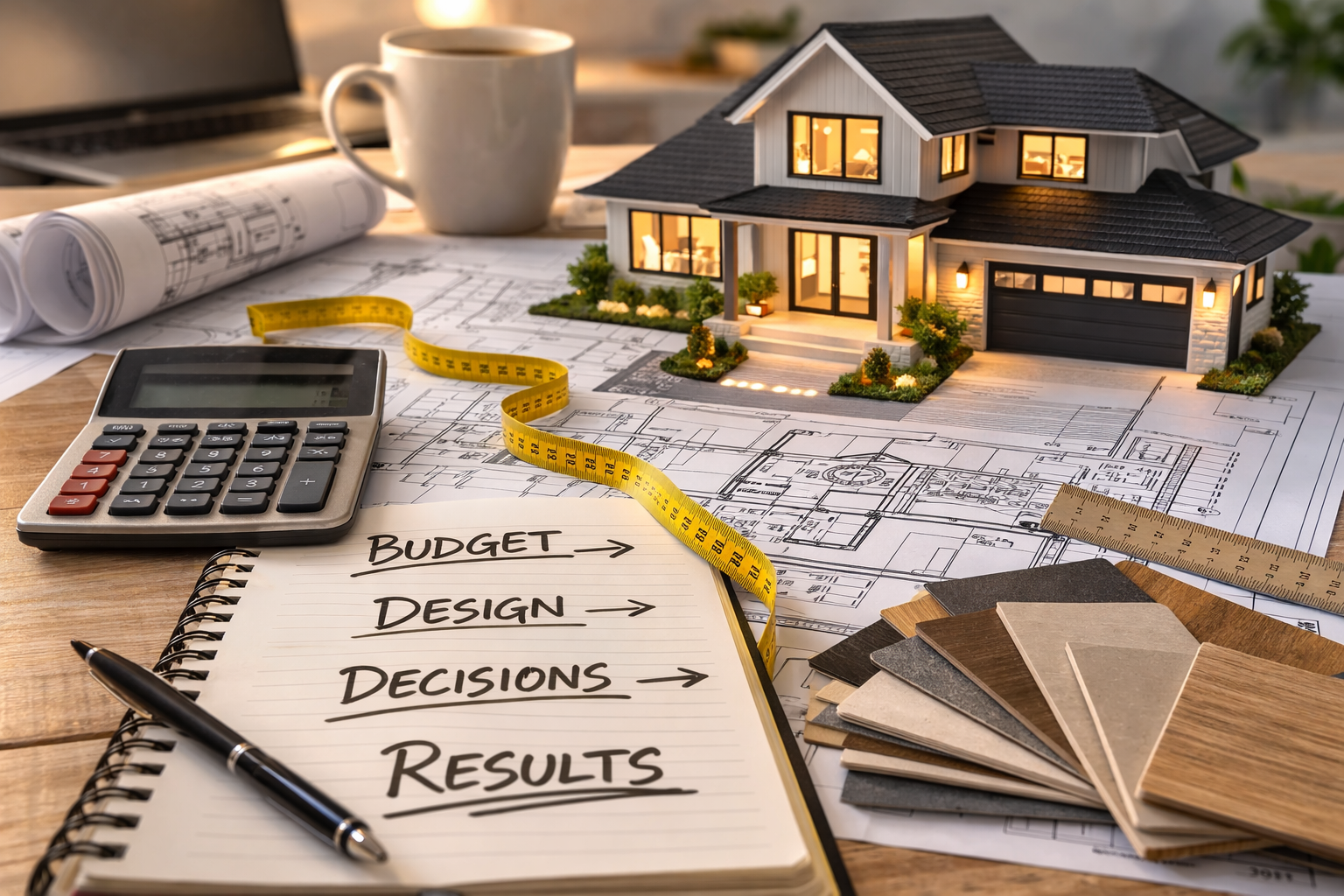
When most homeowners begin thinking about building or remodeling, they start with inspiration.
A photo saved on a phone.
A kitchen seen online.
A dream home spotted while driving through a neighborhood.
There’s nothing wrong with inspiration. It’s exciting. It helps you identify what you love.
But here’s where problems often begin:
Inspiration without financial clarity creates unrealistic expectations.
And unrealistic expectations lead to redesigns, delays, frustration, and unnecessary expense.
If there is one foundational principle that protects homeowners during the design process, it is this:
Clarity about budget creates clarity in design decisions.
This article will explain why your budget should shape your design, not limit it, and how starting with financial alignment actually leads to better outcomes, fewer surprises, and a stronger investment.
Why Inspiration Alone Can Lead You in the Wrong Direction
Inspiration photos show finished results.
They do not show:
- The construction cost
- The engineering behind the scenes
- The structural requirements
- The level of finishes
- The regional labor costs
- The land constraints
They show beauty, not cost.
When a design begins purely from inspiration images, homeowners often unknowingly design a home that may be:
- 20 – 30% larger than their budget supports
- Using finish materials outside their comfort range
- Structurally more complex than necessary
- More expensive to build than anticipated
The problem isn’t dreaming big.
The problem is designing before understanding financial boundaries.
Without cost awareness, you don’t have design direction, you have design drift.
The Difference Between Wishful Budgeting and Realistic Planning
Many homeowners say, “We want to stay around X dollars.”
But there are two very different ways to approach that number.
Wishful Budgeting
Wishful budgeting sounds like this:
- “We hope it stays under this amount.”
- “We’ll figure it out later.”
- “We’ll just remove things if it’s too high.”
- “Prices can’t be that different.”
This approach treats the budget as flexible after design is complete.
The risk?
By the time you get real construction pricing, you may discover:
- The home is significantly over budget.
- Major components must be removed.
- The layout needs to shrink.
- Structural systems need to be simplified.
- Materials must be downgraded.
At that stage, changes are expensive, both financially and emotionally.
Redesigning costs time.
Repricing costs time.
Permits may need adjustments.
Momentum is lost.
Realistic Planning
Realistic planning starts differently.
It asks:
- What is the total investment range we are truly comfortable with?
- Does that include construction, site work, permits, professional fees, and contingency?
- What monthly payment or total investment feels responsible, not stressful?
Realistic planning treats the budget as a design parameter, not a guess.
And that changes everything.
Why Early Cost Awareness Prevents Redesigns
The most expensive time to discover you are over budget is after the design is complete.
When cost alignment happens early:
- Square footage is set intentionally.
- Rooflines are simplified where appropriate.
- Structural spans are designed intelligently.
- Window quantities and sizes are considered strategically.
- Finish levels are discussed realistically.
This doesn’t mean you can’t have what you want.
It means the design is shaped around what is sustainable.
Think of it this way:
If you know you’re building within a specific investment range, you can decide:
- Do I want more square footage, or higher-quality finishes?
- Do I prefer a simpler footprint with better long-term durability?
- Is a dramatic two-story great room worth the added structural cost?
- Would reallocating space improve daily function?
Those are empowered decisions.
Without budget clarity, those decisions are accidental.
Bigger Isn’t Always Better
One of the most common design traps is assuming more square footage equals better value.
In reality:
- Larger homes cost more to build.
- Larger homes cost more to heat and cool.
- Larger homes require more roofing, framing, siding, and foundation.
- Larger homes require more maintenance long term.
When budget guides design, you begin asking smarter questions:
- How much space do we truly use?
- Can layout efficiency replace square footage?
- Would better storage reduce the need for more rooms?
- Can ceiling height and light make rooms feel larger without expanding the footprint?
Often, a well-designed 2,400 square foot home lives better than a poorly planned 3,200 square foot home.
That is the power of intentional design shaped by financial clarity.
How Good Design Protects Your Investment
Your home is likely one of the largest investments you will ever make.
Good design is not about making something look impressive on paper.
Good design:
- Reduces costly mid-construction changes.
- Prevents overspending in low-impact areas.
- Prioritizes structural efficiency.
- Balances beauty with buildability.
- Supports long-term durability.
- Improves resale strength.
When budget and design are aligned from the beginning, you avoid the domino effect of “fixing” a project during construction.
Construction is the most expensive place to make decisions.
Design is the least expensive place to make them.
That distinction alone protects thousands, sometimes tens of thousands, of dollars.
The Designer’s Role: Guide, Not Gatekeeper
A good residential designer does not use your budget to restrict you.
They use it to guide you.
The role of a designer is to:
- Translate vision into buildable reality.
- Explain how design decisions affect cost.
- Help prioritize what matters most.
- Identify areas where cost can be managed without sacrificing impact.
- Coordinate with builders to maintain alignment.
This process requires honest conversations.
It may involve:
- Adjusting square footage.
- Simplifying structural elements.
- Choosing materials strategically.
- Phasing certain features for the future.
But these decisions are thoughtful, not reactive.
The result is a home designed intentionally around your real-life investment range.
What Happens When Budget Leads Design
When homeowners embrace financial clarity early, something important happens:
Stress decreases.
You stop wondering:
- “Are we going too far?”
- “Will this come back higher than we expect?”
- “Are we setting ourselves up for disappointment?”
Instead, the design becomes focused.
Every decision has context.
Every trade-off is intentional.
Every adjustment supports the larger goal.
That is when the design process becomes empowering rather than overwhelming.
Clarity Creates Confidence
At its core, the design process is not about drawing rooms.
It is about creating clarity.
Clarity about:
- Lifestyle
- Priorities
- Long-term plans
- Financial comfort
- Construction reality
When budget clarity comes first, design becomes a disciplined process, not an emotional roller coaster.
And that discipline protects your time, your investment, and your peace of mind.
The Foundation for the Rest of This Month
Throughout this month, we’ll explore specific topics that build on this principle:
- Why bigger isn’t always better
- How to balance beauty, budget, and buildability
- How design decisions impact cost more than most homeowners realize
- How to prioritize what truly adds value
But they all connect back to one core idea:
Clarity about budget creates clarity in design decisions.
When you understand that principle early, you don’t just design a house.
You design responsibly.
And that is what leads to a home that feels right, both emotionally and financially, for years to come.
Thinking about building, adding on, or redesigning your home?
If you’re early in the planning process, or even just trying to figure out where to start, I offer a free 30-minute phone consultation to talk through your ideas, answer questions, and help you understand next steps.
📧 Email: info@dennisfletcherdesignstudio.com
Leave a Reply