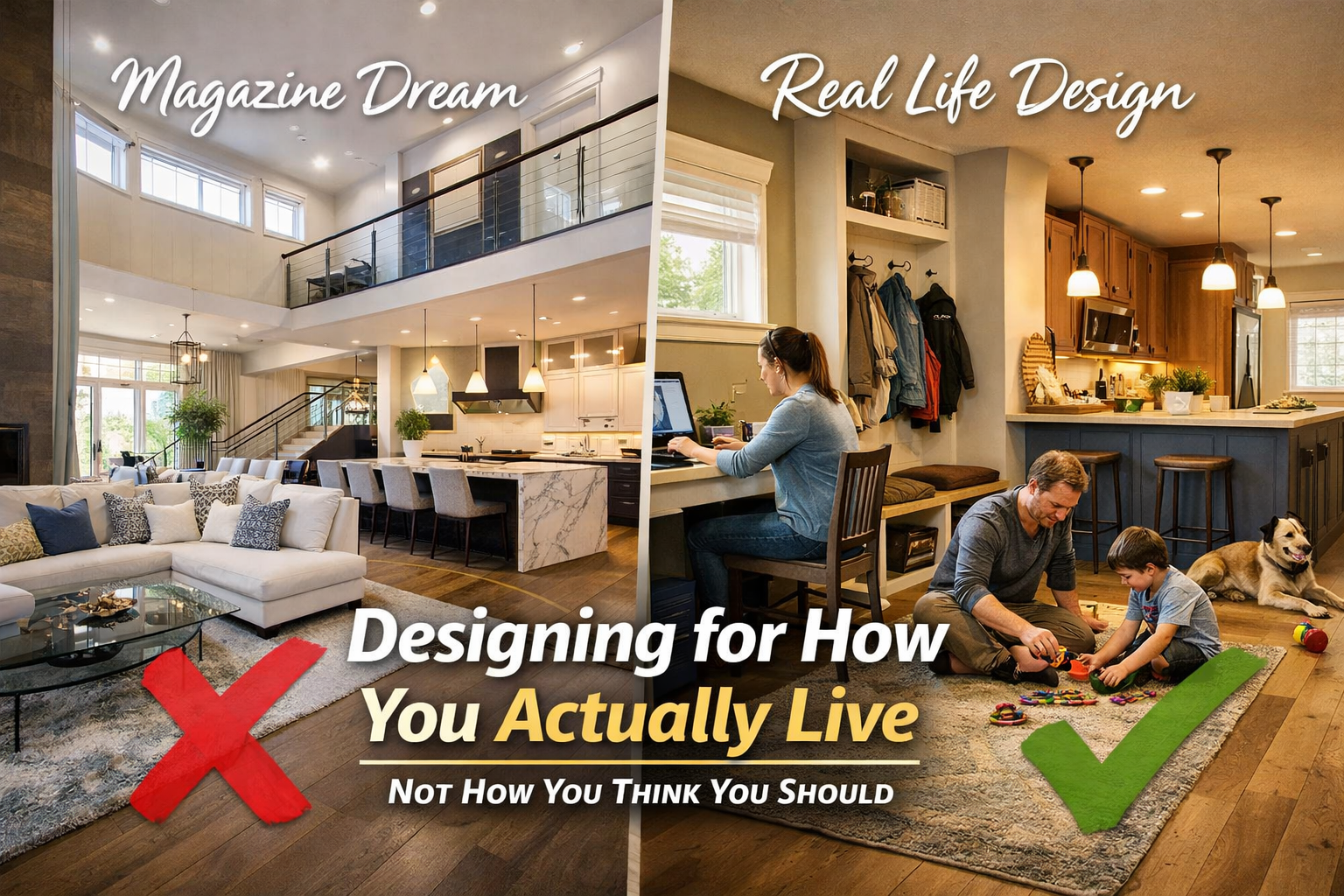
Why magazine-perfect homes often fail real families—and how smarter design decisions lead to long-term comfort, efficiency, and happiness.
If you’ve spent any time researching new homes online, you’ve probably noticed a pattern.
Open-concept everything. Oversized kitchens. Double-height living rooms. Perfectly staged spaces that look incredible—but feel strangely unfamiliar.
For homeowners planning to build a new home in 2026, this creates a quiet but costly problem: many homes are being designed around aspiration instead of reality.
This article is a continuation of “What a Home Designer Actually Does (And Why It Matters More Than You Think)”, and it explores one of the most overlooked parts of the design process—aligning your home with the way you truly live, not the way a magazine says you should live.
The Magazine Trap: When “Looks Good” Doesn’t Mean “Works Well”
Design inspiration is not the enemy.
The problem arises when inspiration becomes instruction.
Magazine layouts and social media images are designed to:
- Photograph well
- Sell a lifestyle
- Appeal to the widest possible audience
They are not designed around your daily routines, your habits, your land, or your long-term needs.
What works for a staged 3,800-square-foot home on a flat suburban lot may be completely wrong for:
- A rural or coastal property
- A narrow or irregular parcel
- A couple planning to age in place
- A family that works from home
- A household with pets, hobbies, or multi-generational needs
Designing from images alone often leads to expensive course corrections once construction begins.
Why “How You Live” Should Drive Every Major Design Decision
A well-designed home doesn’t force you to adapt—it adapts to you.
A professional designer looks beyond aesthetics and asks deeper questions:
- Where do you naturally drop your keys and bags?
- Do you cook daily or mostly reheat?
- Do you host large gatherings or prefer quiet evenings?
- How will this house function in 10, 20, or 30 years?
- Which rooms will be used every day—and which rarely?
When these questions aren’t asked early, homeowners often end up with:
- Beautiful rooms they don’t use
- Awkward circulation paths
- Poor storage placement
- Spaces that feel “off” but are hard to explain
Common “Aspirational” Design Choices That Backfire
1. Oversized Open-Concept Living Spaces
Why people want them:
They feel modern, bright, and social.
Why they can be problematic:
- Noise travels everywhere
- Heating and cooling costs increase
- Furniture layouts become difficult
- Privacy disappears
- Structural costs rise due to long spans
On smaller lots or in zoning districts with height or footprint limits, open-concept designs can force uncomfortable compromises elsewhere.
Better approach:
Design connected spaces with subtle separation, allowing flexibility without sacrificing comfort or acoustics.
2. Kitchens Designed for Entertaining—Not Cooking
Why people want them:
They look impressive and photograph beautifully.
Why they often fail:
- Work triangles ignored
- Islands oversized and awkward
- Storage sacrificed for aesthetics
- Circulation conflicts during actual use
A kitchen should be designed around how you cook, not how guests might admire it twice a year.
3. Rooms You “Might” Use Someday
Formal dining rooms. Sitting rooms. Bonus spaces with no defined purpose.
Why this is risky:
- Every square foot costs money to build and maintain
- Zoning and lot coverage limits may restrict overall size
- Underused rooms often steal space from high-use areas
A designer helps prioritize daily-use spaces first, then layers in secondary functions where appropriate.
Land, Zoning, and Permitting: The Reality Check Most People Miss
One of the biggest dangers of designing from inspiration alone is ignoring regulatory constraints.
Zoning Regulations Can Affect:
- Maximum home size
- Building height
- Setbacks from property lines
- Lot coverage
- Accessory structures
Permitting Regulations Can Affect:
- Stair geometry
- Bedroom placement
- Egress requirements
- Ceiling heights
- Energy efficiency standards
A layout that looks perfect online may be unbuildable, or require costly redesign, once local codes are applied.
Designers understand how to:
- Shape the home to the land
- Maximize usable space within zoning limits
- Avoid permit delays and redesign fees
- Prevent change orders during construction
Designing for the Life You’ll Actually Live in 5–20 Years
Homes should not only meet today’s needs—but anticipate tomorrow’s realities.
Consider:
- Aging in place
- Remote or hybrid work
- Reduced mobility
- Future caregiving needs
- Changing family dynamics
Designing with flexibility early often costs less than retrofitting later.
Examples include:
- Main-level living options
- Wider hallways
- Strategic bathroom placement
- Adaptable rooms with multiple uses
What Not to Do (And Why)
❌ Don’t copy a plan without understanding your land
❌ Don’t oversize rooms without purpose
❌ Don’t design for resale over livability
❌ Don’t ignore zoning and permitting early
❌ Don’t assume “bigger” means “better”
Each of these decisions can quietly add tens of thousands of dollars in construction costs, delays, or future renovations.
How This Connects Back to the Role of a Home Designer
This is where professional design truly earns its value.
A home designer:
- Translates lifestyle into layout
- Balances inspiration with reality
- Anticipates regulatory constraints
- Protects your budget
- Prevents costly mistakes before they happen
Design is not about imposing taste—it’s about advocacy and foresight.
Final Thought: A Home That Works Quietly Is a Home Done Right
The best homes don’t announce themselves.
They simply work—day after day, year after year.
When your home is designed around how you actually live, you stop noticing it—and that’s the highest compliment design can receive.
Thinking About Building in 2026?
If you’re planning a new home and want to avoid costly surprises later, this is the moment to slow down—just enough to do things in the right order.
Getting clarity early is one of the smartest financial decisions you can make in a custom home project.
Leave a Reply