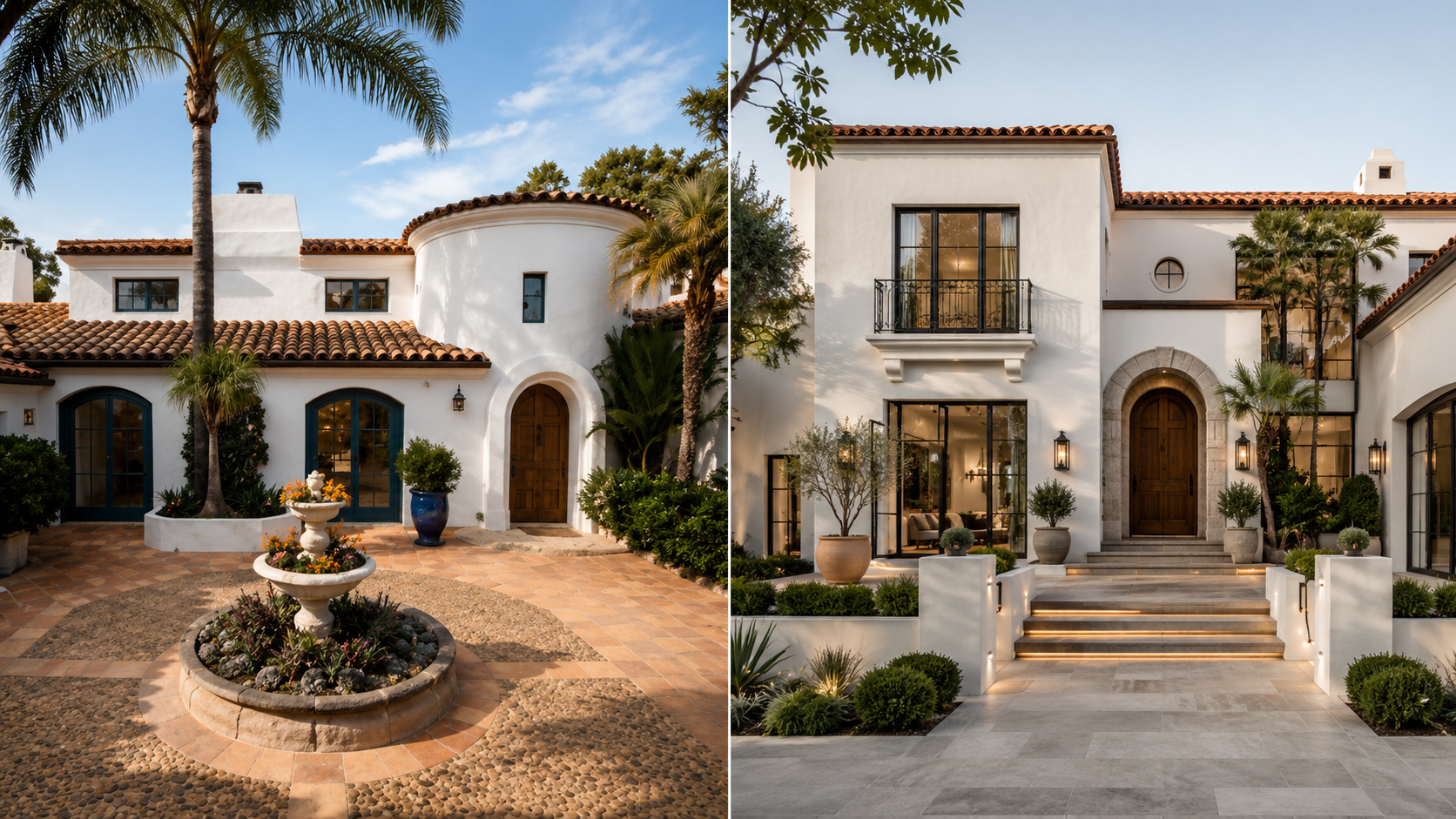
Courtyards, Stucco, Tile, and Regional Character
When most people think about Spanish Colonial Revival homes, they often picture white stucco walls, red clay tile roofs, arched doorways, wrought iron details, heavy wood doors, colorful tile, and sunny courtyards.
Those features are easy to recognize, but they are only part of the story.
Spanish Colonial Revival design is not simply a collection of decorative details. At its best, it is a warm-climate residential design type shaped by climate, regional identity, outdoor living, shade, privacy, and architectural traditions brought into American home design during the late 19th and early 20th centuries.
Like the other home types in this American regional design series, Spanish Colonial Revival homes make more sense when we look at why they developed.
A Cape Cod home makes sense when you understand cold New England weather. A Lowcountry home makes sense when you understand heat, humidity, flooding, and outdoor living. A Prairie Style home makes sense when you understand the wide, horizontal landscapes of the Midwest.
Spanish Colonial Revival homes make sense when you understand sun, heat, thick walls, shaded outdoor spaces, regional craft, and the desire to create homes that feel connected to the history and landscape of places like California, the Southwest, Texas, Florida, and other warm-climate regions.
For homeowners today, Spanish Colonial Revival design offers an important lesson: a home can be beautiful, comfortable, and deeply regional when the exterior materials, roof shape, windows, courtyards, shaded areas, and interior planning all work together.
What Is a Spanish Colonial Revival Home?
A Spanish Colonial Revival home is a residential design type inspired by earlier Spanish colonial architecture, Mediterranean influences, Mission architecture, regional adobe traditions, and early 20th-century revival design.
In the United States, this style became especially popular in California, the Southwest, Texas, Florida, and other areas where the climate, landscape, and cultural history supported the look and function of the design.
These homes are often recognized by their:
Stucco exterior walls
Clay tile roofs
Arched doorways and windows
Courtyards or patios
Covered walkways and arcades
Wrought iron details
Heavy wood doors
Decorative tile accents
Simple wall surfaces
Deep window openings
Balconies, towers, or low roof forms
Strong indoor-outdoor connections
The overall feeling is warm, textured, shaded, and inviting.
A well-designed Spanish Colonial Revival home should not feel like a plain house with a few arches attached to it. The style works best when the major parts of the home support the same idea: shelter from the sun, connection to outdoor spaces, simple forms, honest materials, and regional character.
That is what makes this style so appealing. It can feel elegant without being overly formal. It can feel historic without feeling stiff. It can feel relaxed without feeling unfinished.
Where Spanish Colonial Revival Homes Are Most Commonly Found
Spanish Colonial Revival homes are most commonly associated with California, the Southwest, Texas, Florida, and other warm-climate regions of the United States.
They are especially common in areas where Spanish colonial influence, Mission architecture, Mediterranean climate, and early 20th-century development all came together.
You may see the style in:
Southern California neighborhoods
Southwestern desert communities
Texas residential areas
Florida coastal towns
Resort communities
Historic districts
Custom homes in warm climates
New traditional neighborhoods
Luxury residences with courtyard planning
The style spread because it felt appropriate to the land and climate. Stucco walls made sense in dry and sunny areas. Clay tile roofs helped create a strong regional identity. Courtyards provided private outdoor living space. Covered walkways and shaded porches helped protect people from direct sun.
Of course, not every Spanish Colonial Revival home is in the Southwest or California. The style has been borrowed throughout the country. But it is most convincing when the home’s design responds to climate, site, and lifestyle rather than simply copying a few visual features.
That is an important point for homeowners.
A Spanish Colonial Revival-inspired home in a hot, dry, sunny climate may feel natural. The same design copied without thought in a cold, snowy region may need careful adaptation. Roof pitch, drainage, insulation, exterior materials, and maintenance all need to be considered.
A good design does not force a style onto a property. It studies the property first, then adapts the style in a way that makes sense.
A Brief History of Spanish Colonial Revival Design
Spanish Colonial Revival architecture became popular in the United States during the late 19th and early 20th centuries. It developed as part of the broader Colonial Revival movement, but instead of looking mainly to English colonial architecture, Spanish Colonial Revival looked to Spanish-influenced architecture, Mission buildings, Mediterranean traditions, and regional forms associated with the American West, Southwest, and Florida.
The style became especially visible after the 1915 Panama-California Exposition in San Diego. That exposition helped introduce many people to a romanticized version of Spanish and Mediterranean-influenced architecture. The buildings used white stucco, tile roofs, towers, arcades, courtyards, ornamented entries, and dramatic outdoor spaces. The look became strongly associated with California and warm-climate elegance.
As the style spread, it appeared in houses, hotels, civic buildings, schools, churches, resorts, and commercial buildings. In residential design, it offered something that felt both historic and fresh. It was not the same as the older Colonial homes of the Northeast. It felt sunlit, regional, relaxed, and well suited to outdoor living.
Spanish Colonial Revival design also arrived at a time when many Americans were becoming more interested in regional identity. Builders, architects, and homeowners were not only asking, “What does a fashionable house look like?” They were also asking, “What kind of home belongs in this place?”
That question is one reason the style still matters.
When Spanish Colonial Revival design is handled well, it does not feel like costume architecture. It feels like a design response to climate, craft, culture, and daily life.
Why Climate Matters in Spanish Colonial Revival Design
Spanish Colonial Revival homes are strongly connected to warm-climate living.
Many of the style’s most recognizable features help address sun, heat, glare, and the desire for comfortable outdoor spaces.
The stucco walls, clay tile roofs, courtyards, shaded arcades, smaller punched windows, deep overhangs, and covered entries all work together to create a home that feels protected from harsh sunlight while still connected to the outdoors.
That is very different from a cold-climate home where the main design priorities may include conserving heat, shedding snow, reducing exterior exposure, and minimizing air leakage.
In warm regions, shade becomes a major design tool.
Shade can make a front entry more comfortable. It can protect windows. It can make outdoor spaces usable for more of the day. It can reduce glare. It can help exterior walls feel cooler. It can make the transition from outside to inside feel softer and more pleasant.
Spanish Colonial Revival homes often use architecture itself to create shade. Instead of relying only on umbrellas, awnings, or landscaping, the building form provides protection through roof overhangs, arcades, deep window openings, balconies, porches, and courtyards.
For homeowners, this is a helpful lesson. Comfort is not only created by mechanical systems. Comfort is also created by good design.
A home that is planned with the sun in mind can feel better, function better, and often look better.
Defining Feature: Stucco Walls
One of the most recognizable features of Spanish Colonial Revival homes is the use of stucco exterior walls.
Stucco gives the home a smooth, solid, sculpted appearance. It works especially well with simple wall forms because it allows light and shadow to become part of the design. In bright sunlight, a plain stucco wall can have a quiet beauty. It does not always need heavy decoration.
Stucco also helps create the thick-walled appearance associated with many Spanish and Mediterranean-influenced buildings. Even when modern construction uses wood framing, masonry, or other wall systems beneath the surface, the stucco finish can give the home a feeling of mass and permanence.
This matters because Spanish Colonial Revival design often depends on solid wall surfaces.
Unlike some styles that rely on lots of trim, siding patterns, brackets, shutters, and layered ornament, Spanish Colonial Revival homes often use restraint. A clean stucco wall, a deep arch, a tile roof, and a beautiful wood door may be enough.
For homeowners, the lesson is simple: more detail is not always better.
A Spanish Colonial Revival home can lose its character if too many materials are added. Stone, brick, siding, oversized trim, multiple stucco colors, and unrelated details can make the home feel confused. The strength of the style often comes from simple forms, strong proportions, and carefully placed accents.
Stucco can be beautiful, but it also needs proper detailing. Drainage, flashing, control joints, wall assemblies, climate, and installation quality all matter. A stucco home should be designed and built with care, not treated as a quick exterior finish.
Defining Feature: Clay Tile Roofs
The clay tile roof is another major feature of Spanish Colonial Revival design.
The roof often uses red or terra-cotta-colored barrel tiles, S-tiles, or similar clay tile profiles. These roofs help define the regional character of the home. They also create texture, shadow, and warmth against the smoother stucco walls.
The contrast between a light stucco wall and a rich clay tile roof is one of the classic visual combinations of the style.
Roof shape matters too.
Spanish Colonial Revival homes may use low-pitched roofs, hipped roofs, gabled roof forms, shed roof portions, or combinations of roof forms. The roof is often not as steep or visually dominant as what you might see on a Cape Cod or Tudor home. Instead, the roof tends to sit comfortably over thick walls, shaded entries, and outdoor spaces.
Clay tile roofs can be long-lasting when properly installed, but they also require the right structure and detailing. Tile roofing is heavier than many other roofing materials, so the roof framing must be designed to support it. The underlayment, flashing, valleys, hips, ridges, and penetrations all need careful attention.
For modern homeowners, there are also alternative materials that mimic the look of clay tile while reducing weight or maintenance concerns. These may be appropriate in some situations, but the choice should be made carefully. A roof material can strongly affect the authenticity and overall character of the home.
In Spanish Colonial Revival design, the roof is not just a protective covering. It is one of the main visual elements that tells the viewer what kind of home they are looking at.
Defining Feature: Courtyards
Courtyards are one of the most important features of Spanish Colonial Revival design.
A courtyard is an outdoor space that is partially or fully enclosed by the building, walls, landscaping, or surrounding structures. It can be located near the entry, in the center of the home, along one side, or at the rear of the house.
Courtyards are important because they create private outdoor rooms.
Instead of the yard being only something you look at through a window, the courtyard becomes part of daily life. It can be used for morning coffee, outdoor dining, reading, small gatherings, container gardens, fountains, shaded seating, or simply as a peaceful transition between spaces.
In warm climates, this can be especially valuable. A courtyard can provide outdoor living space that feels protected from wind, street noise, harsh sun, or public view. It gives the home a sense of retreat.
Courtyards also affect the interior.
Rooms arranged around a courtyard can receive light from multiple directions. Interior spaces can open to the courtyard with doors, windows, or covered walkways. The courtyard can become a visual anchor for the home, helping the floor plan feel organized and connected.
For modern homeowners, this is one of the best ideas to borrow from Spanish Colonial Revival design.
Even if a full central courtyard is not practical, the same principle can be used in smaller ways. A protected side patio, an entry court, a walled garden, a screened outdoor room, or a private rear terrace can all create a similar feeling.
The key is to design the outdoor space as part of the home, not as leftover yard space after the house is finished.
Defining Feature: Arcades and Covered Walkways
Arcades and covered walkways are common in Spanish Colonial Revival design.
An arcade is a series of arches supported by columns or piers. It may run along a porch, courtyard, patio, or exterior walkway. In residential design, an arcade can create a beautiful shaded transition between indoor and outdoor spaces.
This feature is both practical and attractive.
The practical purpose is shade. A covered walkway protects people from direct sun and light rain. It can make outdoor circulation more comfortable. It can also shade doors and windows, reducing glare and heat exposure.
The visual purpose is rhythm. Repeating arches create a sense of order and movement. They soften the exterior and give the home a handcrafted, regional character.
Arcades also help connect parts of the home. A covered walkway might link a main living area to a guest suite, garage, outdoor kitchen, pool area, or courtyard. Instead of treating outdoor circulation as an afterthought, the architecture makes it part of the experience.
For homeowners, this idea can be very useful in custom design.
A covered walkway can make a home feel more graceful. It can help organize an entry sequence. It can frame a view. It can make a courtyard feel more complete. It can also provide a comfortable outdoor path between different parts of the property.
As with any strong design feature, proportion matters. Arches that are too thin, too wide, too flat, or too decorative can feel awkward. The arcade should feel like it belongs to the structure, not like a decorative piece attached afterward.
Defining Feature: Arched Openings
Arched openings are another signature feature of Spanish Colonial Revival homes.
You may see arches at front doors, porch openings, window openings, interior passageways, fireplaces, courtyards, and arcades. The arch adds softness and character to the design.
In a home with mostly simple stucco walls, an arched opening can become a beautiful focal point.
Arches are powerful because they change the feeling of a space. A square opening can feel clean and modern. An arched opening can feel warmer, older, softer, and more crafted. In Spanish Colonial Revival design, arches help create a sense of regional identity and visual continuity.
But arches should be used carefully.
One common mistake is adding arches randomly. If the front porch has arches, the interior has no related details, the windows are standard rectangles, and the rest of the house follows another style, the result may feel disconnected.
Another mistake is using arches where the proportions do not work. An arch needs the right height, width, wall thickness, and surrounding space. A poorly proportioned arch can look forced.
Good Spanish Colonial Revival design uses arches with intention. They should reinforce the main design idea and appear in places where they make architectural sense.
Defining Feature: Wrought Iron Details
Wrought iron details are often used in Spanish Colonial Revival homes.
These may appear as balcony railings, stair railings, window grilles, gates, lanterns, hardware, light fixtures, or decorative accents. Wrought iron provides contrast against stucco walls and wood doors. It adds craftsmanship without overwhelming the exterior.
The key is restraint.
A little wrought iron can be beautiful. Too much can make the home feel busy or theatrical.
In a well-designed home, wrought iron details are usually placed where they serve a purpose. A railing protects a balcony. A gate defines an entry court. A lantern marks a doorway. A grille adds security or visual interest to a window. Hardware gives weight and texture to a wood door.
For modern homeowners, wrought iron can still work beautifully, but it should be selected carefully. The design, finish, scale, and placement should match the overall character of the home.
Simple, well-proportioned ironwork often looks better than overly elaborate pieces.
Defining Feature: Wood Doors and Beams
Heavy wood doors are another common feature of Spanish Colonial Revival homes.
The front door is often one of the most important design moments. A thick wood door set into a stucco wall, framed by an arch or shaded entry, can create a strong sense of arrival.
Wood doors may include panels, iron hardware, small windows, carved details, or plank-style construction. The goal is usually to create warmth and craft.
Wood may also appear in ceiling beams, lintels, shutters, gates, pergolas, or interior details. In many Spanish Colonial Revival homes, wood provides a warm counterpoint to the cooler surface of stucco and plaster.
Again, restraint matters.
The wood should feel substantial and intentional. Thin decorative pieces applied without purpose can weaken the design. A few strong wood elements often work better than many small ones.
For homeowners, this is a useful reminder that material contrast matters. Stucco, tile, iron, wood, and decorative tile each bring a different texture. When used well, they create depth and richness. When overused, they compete with each other.
Defining Feature: Decorative Tile
Decorative tile is one of the most charming features of Spanish Colonial Revival design.
Tile may appear on stair risers, fountains, fireplaces, kitchen backsplashes, bathroom walls, entry floors, courtyard details, niches, or accent panels.
Colorful tile can bring pattern, craft, and personality into the home. It can also create a strong connection between interior and exterior spaces. A tile detail used near the entry might relate to a tile fireplace surround inside or a fountain in the courtyard.
The important thing is placement.
Decorative tile works best when it is treated as an accent, not as a random decoration. A tiled stair riser can be beautiful. A tile fountain in a courtyard can become a focal point. A tile fireplace surround can anchor a living room. But if tile appears everywhere without a plan, the home can begin to feel cluttered.
Spanish Colonial Revival design often succeeds because the major forms are simple and the accents are meaningful.
That balance is worth protecting.
Interior Planning in Spanish Colonial Revival Homes
The interior of a Spanish Colonial Revival home should feel connected to the exterior.
That does not mean every room needs arches, tile, iron, and beams. It means the planning, materials, light, and transitions should support the same design idea.
Interior spaces may include:
A strong entry sequence
Views toward a courtyard or patio
Thick-feeling wall openings
Arched passageways
Wood ceiling beams
Plaster or smooth wall finishes
Tile floors or accents
Fireplaces with simple massing
Indoor-outdoor connections
Rooms arranged around outdoor space
Shaded transitions between rooms and patios
Older Spanish Colonial Revival homes may have more separated rooms than many modern homeowners expect. Today, homeowners often want larger kitchens, open living areas, more storage, bigger closets, home offices, and better connections between rooms.
The challenge is updating or designing the home for modern living without losing its character.
A fully open plan can work, but it should still have definition. Ceiling beams, partial walls, arches, fireplaces, flooring changes, furniture groupings, and views to outdoor spaces can help organize the interior.
A Spanish Colonial Revival home should not feel like a generic modern floor plan hidden behind a stucco exterior. The inside and outside should belong to the same idea.
Why Outdoor Living Is So Important
Outdoor living is one of the most important ideas behind Spanish Colonial Revival design.
In warm climates, outdoor spaces are not just decorative. They are part of how people live.
A courtyard, patio, terrace, loggia, balcony, or shaded porch can function almost like another room. These spaces can support dining, relaxing, entertaining, gardening, cooking, and quiet retreat.
The difference between a basic patio and a well-designed outdoor room is intention.
A basic patio may be a slab outside the back door. A well-designed outdoor room considers shade, privacy, furniture placement, views, circulation, lighting, materials, and how people move between inside and outside.
Spanish Colonial Revival homes often handle this beautifully because outdoor spaces are part of the architectural composition.
The house may wrap around a courtyard. A covered arcade may frame a patio. French doors may connect the living room to a terrace. A fountain may create sound and focus. A low wall may define privacy without completely closing off the space.
For homeowners planning a new custom home, this is a major opportunity. Outdoor spaces should be considered early in the design process. They should not be added after the floor plan is already complete.
The best outdoor living spaces feel like they were always meant to be there.
How Spanish Colonial Revival Homes Are Used Today
Spanish Colonial Revival design remains popular in many parts of the United States, especially in warm-climate residential design.
Today’s homes may borrow the style in several ways.
Some homeowners want a historically faithful Spanish Colonial Revival home, especially in neighborhoods where the style is already established. Others want a looser interpretation that uses stucco, tile roofs, arched openings, and courtyards without copying every historic detail.
Modern versions often include:
Larger kitchens
Open living and dining areas
Indoor-outdoor entertaining spaces
Outdoor kitchens
Pools and terraces
Larger primary suites
Home offices
Energy-efficient windows and doors
Improved insulation
Modern mechanical systems
Attached garages
Better storage and mudrooms
Aging-in-place features
These modern needs can fit the style, but they need to be handled thoughtfully.
For example, a large attached garage can easily disrupt the charm of a Spanish Colonial Revival home if it dominates the front elevation. A better design might place the garage to the side, set it back, use carriage-style doors, soften it with landscaping, or connect it through a courtyard or covered walkway.
Large windows also need care. Many homeowners want bright interiors and big views, but Spanish Colonial Revival design often relies on solid wall surfaces and deep openings. Oversized modern glass walls may work in some cases, but they should be balanced with the character of the home.
Modern design does not mean ignoring the style. It means adapting the style intelligently.
What Homeowners Can Learn from Spanish Colonial Revival Design
Even if you are not planning a Spanish Colonial Revival home, this design type offers several lessons that apply to many custom homes.
1. Outdoor Spaces Should Be Designed Early
Courtyards, patios, porches, and terraces work best when they are part of the home’s original design.
If the outdoor space is planned after the house is finished, it may feel leftover. Spanish Colonial Revival homes remind us that outdoor rooms can be just as important as indoor rooms.
2. Shade Is a Design Tool
Shade affects comfort, appearance, energy use, and the way people experience a home.
Covered walkways, deep openings, roof overhangs, balconies, porches, trees, and courtyards can all help create better living spaces. Shade should not be treated as an afterthought.
3. Simple Forms Can Be Beautiful
Spanish Colonial Revival homes often rely on simple wall surfaces, strong roof forms, and carefully placed accents.
This is a valuable lesson for homeowners who worry that a home needs lots of detail to feel custom. Sometimes the most beautiful homes are the ones with restraint.
4. Materials Should Work Together
Stucco, tile, wood, iron, and decorative tile can create a rich and beautiful home, but only when they are coordinated.
Too many unrelated materials can weaken the design. A clear material palette helps the home feel intentional.
5. Regional Character Matters
A home feels stronger when it responds to its region.
That does not mean every house must follow a local historic style. But it does mean climate, light, landscape, materials, and lifestyle should influence the design.
Spanish Colonial Revival homes are a good reminder that regional character can make a house feel rooted instead of generic.
6. Details Should Have Purpose
Arches, ironwork, tile, beams, and decorative accents should not be pasted on without thought.
The best details support the architecture. They appear where they make sense. They help tell the same story as the rest of the home.
Is Spanish Colonial Revival Right for Every Home?
Spanish Colonial Revival design is beautiful, but it is not right for every property or every homeowner.
It tends to work especially well in warm climates, sunny regions, dry landscapes, coastal areas, and neighborhoods where stucco, tile roofs, courtyards, and shaded outdoor spaces feel appropriate.
It may be more challenging in areas with heavy snow, frequent freeze-thaw cycles, very steep roof requirements, or neighborhoods with a completely different architectural character.
That does not mean the style cannot be adapted. It simply means the design needs to be thoughtful.
A home in a colder region might borrow certain ideas, such as a private courtyard, arched interior openings, warm wood doors, or tile accents, while adjusting the roof pitch, wall assemblies, and exterior materials for the climate.
A home in a more traditional East Coast neighborhood might use subtle Mediterranean or Spanish-inspired details without becoming a full Spanish Colonial Revival design.
The best approach is not to force the style. The best approach is to understand what you love about it.
Do you love the courtyard?
The stucco walls?
The tile roof?
The shaded outdoor living?
The warmth of wood and iron?
The simple massing?
The sense of privacy?
The relaxed elegance?
Once you understand the reason behind the preference, the design can respond more intelligently.
Common Mistakes When Borrowing Spanish Colonial Revival Features
Because Spanish Colonial Revival homes have such recognizable details, it can be tempting to borrow a few features and assume the design will work. But this style can quickly feel awkward if it is handled only on the surface.
Here are a few common mistakes.
Adding Arches Without a Complete Design Idea
Arches can be beautiful, but they do not create the style by themselves. If arches are added randomly to a home that otherwise follows another design language, they can feel forced.
Using Stucco Without Proper Proportion
Stucco walls need good massing, good window placement, and careful detailing. A plain stucco box without thoughtful proportions may feel flat rather than elegant.
Letting the Garage Dominate the Front
Large front-facing garages can weaken the character of a Spanish Colonial Revival home. The garage should be carefully placed and designed so it does not overpower the entry, courtyard, roofline, or main living areas.
Overusing Decorative Tile
Tile is a wonderful accent, but too much tile can become visually busy. It works best when it highlights important moments such as stairs, fireplaces, fountains, backsplashes, or entries.
Mixing Too Many Styles
Spanish Colonial Revival details do not always mix well with unrelated elements. For example, combining random farmhouse brackets, Craftsman columns, modern black metal panels, colonial shutters, and Spanish arches can make the home feel confused.
Forgetting the Outdoor Spaces
A Spanish Colonial Revival-inspired home without meaningful outdoor living space may feel incomplete. Courtyards, patios, shaded entries, and outdoor rooms are part of the style’s strength.
Why Spanish Colonial Revival Still Feels Relevant
Spanish Colonial Revival design remains relevant because many of its core ideas still matter to homeowners today.
People still want homes that feel warm, inviting, and connected to outdoor living. They still want shade, privacy, natural light, beautiful materials, and spaces that feel relaxed but refined. They still want homes with character.
This style also offers something many modern homes lack: a strong sense of place.
A Spanish Colonial Revival home can feel rooted in its climate and region. It can create a private retreat from the street. It can make outdoor living feel natural. It can use simple materials in a way that feels rich and timeless.
The lasting value of the style is not only in the stucco, tile, arches, or ironwork. Its lasting value is in the way those features work together.
A good Spanish Colonial Revival home is not just decorated. It is composed.
The roof, walls, openings, courtyard, shade, materials, and details all support the same design idea.
That is a lesson every homeowner can use.
Final Thoughts
Spanish Colonial Revival homes are a beautiful reminder that residential design is not only about appearance. It is also about climate, culture, comfort, materials, outdoor living, and the feeling a home creates.
This design type became especially important in California, the Southwest, Texas, Florida, and other warm-climate regions because it offered a home that felt suited to sun, shade, privacy, and regional character.
Its stucco walls, clay tile roofs, courtyards, arcades, arched openings, wood doors, wrought iron details, and decorative tile are not just visual features. When used well, they help create a home that feels protected, warm, timeless, and connected to its setting.
For homeowners today, Spanish Colonial Revival design offers more than a historic look. It offers a way of thinking.
Design the outdoor spaces early. Use shade intentionally. Let materials work together. Keep the forms simple. Place details where they matter. Make sure the home responds to its climate, site, and lifestyle.
Whether you are drawn to Spanish Colonial Revival specifically or simply want a home with warmth, privacy, and regional character, the lesson is the same: good design begins by understanding why each decision matters.
Leave a Reply