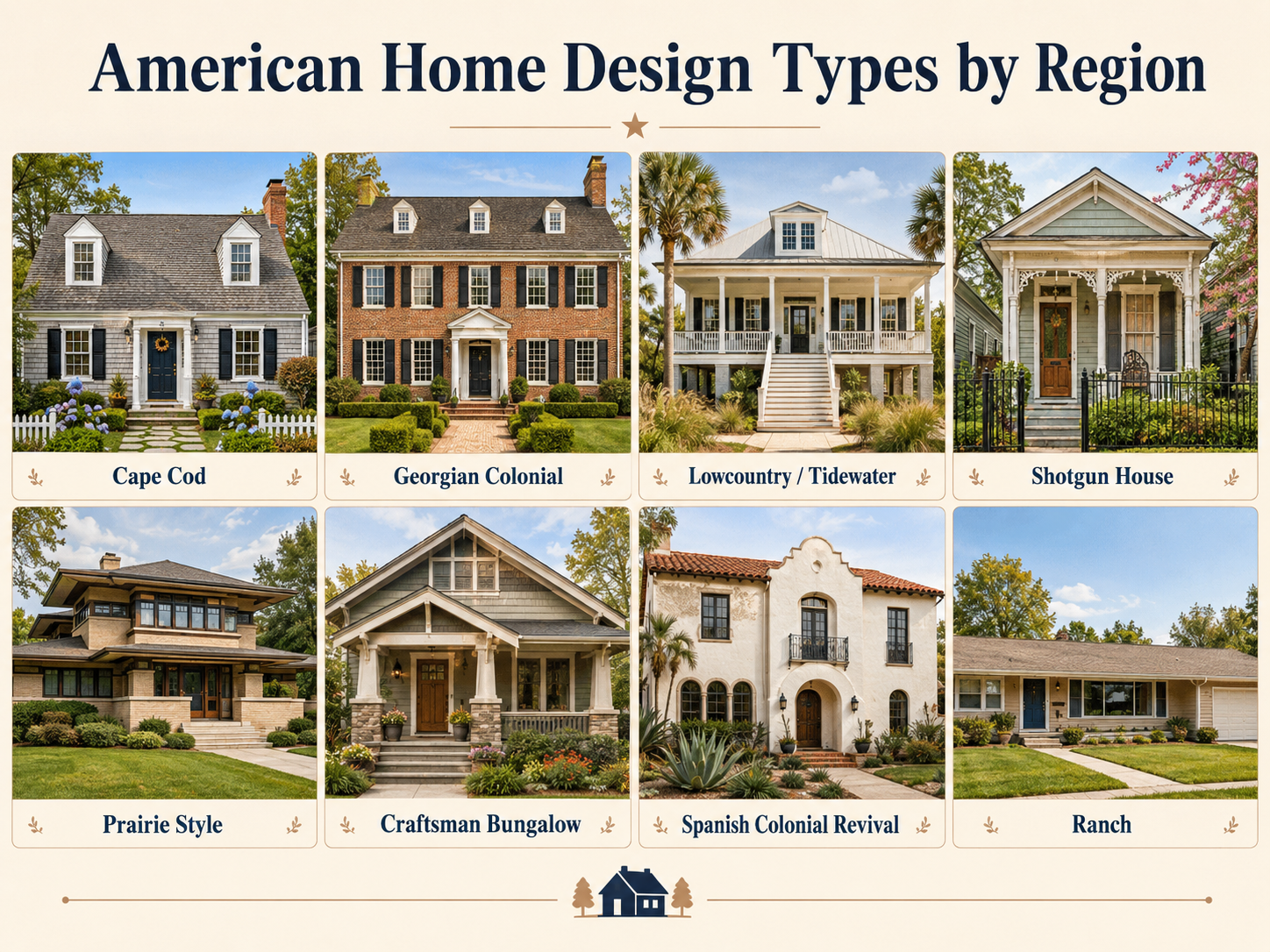
When most homeowners think about house styles, they often start with appearance.
They may picture a steep-roofed Cape Cod, a symmetrical Colonial, a broad front porch, a low Ranch house, or a stucco home with a red tile roof. These images are familiar, but they can also be misleading if we treat them only as decoration.
American home design is not just about style. It is also about response.
Homes developed differently across the United States because people were responding to different climates, landscapes, materials, cultures, lot sizes, construction methods, and ways of living. A house that made sense in coastal New England did not need to solve the same problems as a house in the humid Lowcountry, the open Midwest, a dense Southern city, or the warm Southwest.
That is why understanding regional home design can be so helpful for homeowners.
When you know why certain features were used, you can make better decisions about your own home. You can recognize which traditional ideas are still useful, which ones need to be adapted, and which details may look attractive but do not belong on a particular house.
This guide introduces eight important American home design types by region:
- Cape Cod
- Georgian Colonial
- Lowcountry and Tidewater
- Shotgun House
- Prairie Style
- Craftsman Bungalow
- Spanish Colonial Revival
- Ranch
The goal is not to memorize architectural labels. The goal is to understand the thinking behind the design.
Why American Home Design Changes by Region
A home is always shaped by more than personal taste.
Before modern heating, cooling, insulation, engineered materials, and mechanical systems, houses had to work with local conditions as much as possible. Roofs, porches, walls, windows, foundations, and floor plans were all influenced by practical needs.
In colder regions, homes often became more compact, with steeper roofs and layouts that helped conserve heat. In hot and humid regions, homes often included porches, raised floors, tall ceilings, and windows arranged to encourage airflow. In areas with wide-open landscapes, homes often emphasized horizontal lines and a strong relationship to the land. In dense urban areas, homes adapted to narrow lots and limited frontage.
Regional design was also shaped by culture and settlement patterns.
European building traditions, Indigenous knowledge, African and Caribbean influences, Spanish colonial history, local craftsmanship, transportation routes, industrialization, pattern books, and suburban growth all affected how American homes developed. Over time, some house types stayed closely connected to their original regions, while others spread widely and became part of the national housing vocabulary.
For homeowners, this matters because good design is rarely about copying a look. It is about understanding what a form, feature, or layout is trying to accomplish.
Climate: One of the Strongest Forces in Home Design
Climate has always been one of the most important influences on residential design.
A roof, for example, is not just a visual feature. Its slope, overhang, and shape affect how a home handles rain, snow, heat, shade, and maintenance. A steep roof may help shed snow and rain in a cold climate. A broad overhang may protect walls and windows from sun and storms in a warmer climate. A low roofline may help a house feel visually connected to a flat landscape.
Foundations also respond to region. A raised foundation can improve airflow, protect against dampness, and help lift living spaces above low-level flooding. A slab or crawlspace may make sense in other conditions depending on soil, climate, cost, and construction practice.
Porches, windows, and ceiling heights also tell a regional story.
In hot climates, porches create shade and extend living space outdoors. Large windows and aligned openings can help with cross-ventilation. Tall ceilings allow warm air to rise above the main living area. In colder climates, smaller, more compact forms can make heating more efficient and construction more practical.
These features became recognizable architectural traits, but they began as solutions.
Culture, Materials, and Daily Life
Climate is important, but it is not the whole story.
Regional home types also reflect how people lived. A formal Georgian Colonial house expresses order, symmetry, and social presentation. A Craftsman bungalow emphasizes human scale, honest materials, porches, and built-in function. A Ranch home reflects casual living, the automobile, the backyard, and single-level convenience.
Materials matter as well.
Brick and stone were common in some regions because they were available, durable, and associated with permanence. Wood shingles, clapboard, stucco, tile, and exposed structural details all developed in relation to local materials, craft traditions, and climate needs.
This is why a home can feel “right” in one setting and awkward in another. The issue is not whether a style is good or bad. The issue is whether the design choices are appropriate for the climate, site, scale, materials, and way the homeowners actually live.
1. Cape Cod Homes: Compact Design for New England Weather
The Cape Cod home is strongly associated with New England, especially coastal Massachusetts and the broader Northeast.
At first glance, a Cape Cod house may seem simple: a compact rectangular form, steep roof, central entry, modest windows, and minimal ornament. But that simplicity is part of its strength.

The traditional Cape Cod form made sense in a cold, coastal climate. A compact footprint was easier to build and easier to heat. A steep roof helped shed rain and snow. The simple shape reduced unnecessary complexity. Wood shingles or clapboard siding suited the region’s materials and weathering patterns. In early versions, a central chimney helped distribute warmth through the house.
The Cape Cod is a good example of a home type where restraint is part of the design.
It was not originally about making a grand statement. It was about shelter, efficiency, and practicality. Later Cape Cod Revival homes made the form popular beyond New England, often adding dormers, more finished upper-level space, attached garages, and expanded floor plans.
For homeowners today, the Cape Cod remains useful as a reference for simple, traditional, compact design. But it works best when its proportions are respected. A Cape Cod-inspired home can quickly lose its character if it becomes too large, too wide, or too complicated without careful design.
The lesson of the Cape Cod is that small, clear, well-proportioned forms can be very strong.
2. Georgian Colonial Homes: Symmetry, Order, and Formal Design
Georgian Colonial homes are commonly associated with the Northeast and Mid-Atlantic, especially early American towns and colonial-period settlements.
Unlike the Cape Cod, which is rooted heavily in compact practicality, the Georgian Colonial is known for order and formality. These homes often feature a symmetrical front façade, a centered front door, evenly spaced windows, a side-gabled roof, and classical proportions.
The design reflects ideas of balance, hierarchy, and permanence.
A centered entry often led to a formal hall, with rooms arranged in an orderly way on either side. Brick or stone construction was common in many regions and helped communicate durability. Decorative entry surrounds, shutters, cornices, and carefully arranged windows added refinement without relying on excessive ornament.
For homeowners, the Georgian Colonial is a reminder that exterior organization matters.

Symmetry can make a house feel calm, stable, and timeless. Window spacing, roof shape, door placement, and proportion all work together. When one element is out of balance, the whole front elevation can feel unsettled.
Modern homes often borrow from Georgian Colonial design when homeowners want a traditional, formal appearance. However, the interior usually needs adaptation. Many older center-hall layouts were designed for more separated rooms and formal living patterns. Modern households often want larger kitchens, better family gathering spaces, improved storage, and stronger connections to outdoor areas.
The challenge is to preserve the order and proportion that make Georgian Colonial homes appealing while adapting the plan for the way people live today.
3. Lowcountry and Tidewater Homes: Shade, Airflow, and Coastal Living
Lowcountry and Tidewater homes are associated with the coastal Southeast, including areas of South Carolina, Georgia, Virginia, Maryland, North Carolina, and nearby coastal regions.
These homes developed in response to heat, humidity, rain, damp ground conditions, and coastal living. Their features are not random. They are practical responses to a demanding climate.
Common features include raised foundations or crawlspaces, deep porches, broad roofs, tall ceilings, large windows and doors, and generous shaded outdoor areas. Raising the house can improve airflow beneath the structure and help protect the living space from dampness or low-level flooding. Porches provide shade and create outdoor rooms. Large openings can support cross-ventilation. Tall ceilings help warm air rise above the occupied space.
In this type of home, the porch is not just decoration.

It is part of how the house works. It shades walls and windows, softens the transition between indoors and outdoors, and provides a usable living area protected from direct sun and rain. In warm climates, that shaded transition space can be one of the most important parts of the home.
Modern Lowcountry and Tidewater-inspired homes often include screened porches, elevated living areas, durable exterior materials, large roof overhangs, and strong indoor-outdoor connections. In coastal areas, they may also require careful attention to wind, flood elevation, structural connections, materials, and local building requirements.
For homeowners, the lesson is clear: climate-responsive design can make a home more comfortable, more durable, and more connected to its setting.
4. Shotgun Houses: Narrow Homes with Efficient Plans
The shotgun house is closely associated with New Orleans, the Gulf Coast, and Southern urban communities.
It is typically narrow, often one room wide and several rooms deep, with rooms arranged in a straight line from front to back. Many traditional shotgun houses have a front porch or stoop, doors aligned through the house, and little or no hallway.
This layout was shaped by narrow urban lots, efficient construction, and compact living.
Because the house is narrow, it can fit where wider homes cannot. Because there is little hallway space, more of the floor area can be used as living space. Because rooms are arranged in sequence, the plan is simple and economical to build. Aligned doors and windows can also encourage airflow through the home.

The shotgun house also has an important social and neighborhood dimension. The front porch or stoop creates a connection to the street. In dense neighborhoods, that relationship between house and sidewalk can shape daily life.
Today, shotgun houses are important in preservation, renovation, infill housing, and small-lot design. They are not usually copied directly for large suburban homes, but their lessons remain valuable.
A narrow lot does not automatically mean poor design. A compact home does not have to feel careless. Efficient planning, natural light, storage, privacy, and outdoor connection can make a narrow home work very well.
For homeowners considering additions, accessory dwellings, urban infill, or small-lot homes, the shotgun house shows how design can solve a very specific site problem with clarity and discipline.
5. Prairie Style Homes: Design Shaped by the Midwest Landscape
Prairie Style homes are strongly associated with the Midwest and the Prairie School, including the work of Frank Lloyd Wright and other architects seeking a distinctly American residential architecture.
These homes are known for low horizontal lines, broad overhanging eaves, low-pitched or hipped roofs, grouped windows, open interior spaces, built-in furnishings, and a close relationship to the landscape.
The design makes more sense when you think about the prairie itself.
Rather than reaching upward, Prairie Style homes often stretch outward. Their long rooflines and horizontal emphasis reflect the flat, open landscape. Broad eaves create shade and visually anchor the house to the ground. Grouped windows bring in light while maintaining strong wall planes. Interior spaces often flow more openly than in older, more compartmentalized house types.
Prairie Style design also emphasizes integration.

Architecture, furniture, windows, lighting, fireplaces, and built-ins were often treated as parts of one complete composition. The goal was not just to decorate a house, but to create a unified environment.
Modern homes often borrow Prairie principles without copying historical examples exactly. A new home may use horizontal massing, deep overhangs, natural materials, open living areas, built-ins, and strong site orientation. These ideas can work well for homeowners who want a home that feels grounded, calm, and connected to the land.
The important lesson is that a house should respond to its site.
A Prairie-inspired home is not just a collection of low roofs and wide eaves. At its best, it is a design approach that considers landscape, proportion, light, materials, and interior flow together.
6. Craftsman Bungalows: Honest Materials and Everyday Livability
Craftsman bungalows are associated with California, the Pacific Northwest, and early streetcar suburbs across the United States.
They became widely popular in the early twentieth century and were influenced by the Arts and Crafts movement, which valued craftsmanship, natural materials, and a more human-scaled approach to design.
A Craftsman bungalow often includes a low-pitched roof, deep eaves, exposed rafters, decorative brackets, a wide front porch, tapered porch columns, natural materials, divided-light windows, and built-in cabinetry or seating. Many are one or one-and-a-half stories, making them approachable in scale.
The Craftsman bungalow is important because it combines beauty with usefulness.

The porch extends the living space and connects the home to the neighborhood. Exposed rafters and brackets celebrate the structure rather than hiding it. Built-ins make smaller homes more functional. Natural materials add warmth and texture. The overall effect is comfortable, grounded, and personal.
For homeowners, the Craftsman bungalow shows how detail can serve daily life.
A built-in bench, a well-scaled porch, a properly detailed column, or a carefully placed window can make a home feel more thoughtful. These details are not just decorative when they are designed well. They support how the home is used.
Modern Craftsman-inspired homes remain popular, but they require careful handling. Simply adding brackets or tapered columns to an unrelated house does not automatically create a good Craftsman design. The roof form, porch depth, window proportions, materials, and interior details need to work together.
The lesson of the Craftsman bungalow is that warmth and craftsmanship come from consistency, not from isolated details.
7. Spanish Colonial Revival Homes: Courtyards, Stucco, Tile, and Shade
Spanish Colonial Revival homes are most often associated with California, the Southwest, Texas, Florida, and other warm-climate regions with Spanish colonial influence.
These homes commonly include stucco walls, clay tile roofs, arched openings, courtyards, arcades, balconies, wood doors, decorative tile, wrought iron, and shaded outdoor spaces.
The style is strongly tied to climate and outdoor living.
Stucco walls provide a simple, durable exterior surface. Tile roofs help create the recognizable regional character. Courtyards create private outdoor rooms. Arcades and covered walkways provide shade. Arched openings and handcrafted details add softness, rhythm, and visual interest.

One of the most valuable ideas in Spanish Colonial Revival design is the courtyard.
A courtyard can bring light, air, privacy, and outdoor living into the center of a home. It can create a protected space that feels connected to the house rather than separate from it. In warm climates, this indoor-outdoor relationship can be central to how the home functions.
Modern Spanish Colonial Revival-inspired homes can be beautiful when the elements are used with purpose. But like any regional design type, it can become awkward if reduced to surface decoration. A tile roof, stucco wall, or arch should be part of a larger design idea, not simply applied to make a house look “Spanish.”
For homeowners, the lesson is to think beyond the visual label. The deeper value of this design type is shade, privacy, material simplicity, outdoor rooms, and regional identity.
8. Ranch Homes: One-Story Living and Indoor-Outdoor Connection
The Ranch home is one of the most influential American residential design types.
It is associated with California, the West, the Sunbelt, and postwar suburbs across the country. Ranch homes are typically one story, long and low, with open living areas, attached garages or carports, large windows, sliding doors, patios, and a strong connection to the backyard.
The Ranch reflects a major shift in American living.
Instead of formal rooms stacked on multiple floors, the Ranch emphasized casual, single-level living. Instead of focusing primarily on the front façade, many Ranch homes turned daily life toward the rear yard or patio. Instead of separating the automobile from the house, they often incorporated the garage or carport into the overall design.

The Ranch home also shows how a regional idea can become national.
Its Western and Southwestern influences, combined with suburban expansion, automobile use, and changing family patterns, helped it spread widely. Many homeowners still live in Ranch houses, renovate them, expand them, or borrow from their principles when designing new one-story homes.
For modern homeowners, Ranch homes offer several useful lessons.
Single-level living can improve accessibility and convenience. Open common areas can support casual family life. Large doors and windows can connect the home to outdoor space. A well-designed patio can function as an extension of the interior. A low roofline can help a house feel relaxed and grounded.
However, many existing Ranch homes also need thoughtful updates. Some have dark interiors, undersized kitchens, confusing entries, limited storage, or additions that do not fit the original structure. Good design can improve these homes without erasing what made them work in the first place.
The lesson of the Ranch is that informal living still deserves careful design.
Why Some Home Types Stay Regional and Others Spread
Some American home types remain closely associated with their original regions because their features are tied to specific climate or cultural conditions. A Lowcountry home, for example, makes particular sense in a warm, humid coastal environment. A Cape Cod form is strongly tied to New England weather and building traditions.
Other home types spread more widely because they could be adapted to many places.
The Craftsman bungalow spread through pattern books, builders, and growing neighborhoods. The Ranch spread through suburban development and changing lifestyles. Georgian Colonial design continues to appear in many regions because symmetry and traditional formality have broad appeal.
But when a design type moves from one region to another, it should be adapted thoughtfully.
A porch that works beautifully in a hot climate may need different detailing in a snowy one. A stucco wall assembly that works in a dry climate may require different moisture management in a wetter region. A steep roof may be practical in one setting but visually out of place in another.
Good residential design respects both inspiration and context.
Why Homeowners Should Understand the “Why” Before Borrowing the Look
It is natural for homeowners to collect images of homes they like. Inspiration photos are useful. They help communicate preferences and priorities.
But images can also create confusion.
A homeowner may like the porch from one house, the roof from another, the windows from a third, and the materials from a fourth. If those elements come from different design traditions and different regions, combining them without a clear plan can create a home that feels disjointed.
That is why the “why” matters.
Before borrowing a design feature, ask:
Does this feature make sense for the climate?
Does it fit the scale of the house?
Does it work with the roof form?
Does it support the floor plan?
Does it belong with the materials?
Does it help the home function better?
Does it feel appropriate for the site and neighborhood?
A good design process does not simply ask, “What style do you like?”
It asks, “What is this home trying to do, and how should it respond to the people, place, and conditions around it?”
How Modern Homes Can Reference Traditional Design Without Copying Awkwardly
A modern home does not need to be a museum piece. Homeowners do not have to copy historical houses exactly in order to learn from them.
In fact, copying too literally can create problems. Older homes were designed for different mechanical systems, family patterns, storage needs, kitchens, bathrooms, accessibility expectations, and building codes. A direct copy may not serve modern life well.
A better approach is to identify the principles behind the traditional design.
From Cape Cod homes, you might borrow compact massing, roof clarity, and simple proportions.
From Georgian Colonial homes, you might borrow symmetry, entry emphasis, and balanced window placement.
From Lowcountry homes, you might borrow shaded porches, raised living areas, and cross-ventilation.
From shotgun houses, you might borrow efficient planning for a narrow lot.
From Prairie Style homes, you might borrow horizontal lines, overhangs, and site connection.
From Craftsman bungalows, you might borrow material honesty, porch design, and built-in function.
From Spanish Colonial Revival homes, you might borrow courtyards, shaded outdoor rooms, and simple exterior forms.
From Ranch homes, you might borrow one-story living, indoor-outdoor flow, and casual open planning.
The best modern homes often reinterpret tradition rather than imitate it.
They understand proportion, climate, materials, and lifestyle. They use historical ideas as guidance, not as a costume.
What This Means for Your Own Home
Whether you are building a new home, planning an addition, or redesigning an existing house, regional design can help you make better decisions.
It can help you understand why certain rooflines feel appropriate.
It can help you choose porch depth, window placement, and exterior materials more thoughtfully.
It can help you avoid combining unrelated features that compete with each other.
It can help you communicate more clearly with your designer, builder, or contractor.
It can help you see your home as a complete system rather than a collection of separate choices.
Most importantly, it can help you slow down and make decisions in the right order.
The design process is not about rushing to pick a style name. It is about understanding the site, climate, budget, structure, floor plan, materials, and daily needs of the people who will live there.
Style matters, but it should come from the design logic of the home.
When the form, function, materials, and details all support each other, the result is a home that feels more natural, more comfortable, and more lasting.
A Better Way to Think About American Home Design
American home design is rich because the country itself is varied.
A Cape Cod home and a Lowcountry home solve different problems. A Georgian Colonial and a shotgun house express different social and urban patterns. A Prairie Style home and a Ranch home relate to land and lifestyle in different ways. A Craftsman bungalow and a Spanish Colonial Revival home both value craft and comfort, but they express those values through different materials, forms, and regional traditions.
None of these design types is simply a look.
Each one carries lessons about climate, culture, construction, proportion, and the way people live. For homeowners, those lessons are more valuable than labels.
When you understand why a home type developed, you are better prepared to decide whether its ideas belong in your own project. You can borrow thoughtfully, adapt carefully, and avoid design choices that feel disconnected from the house as a whole.
A well-designed home does not have to copy the past.
But it should learn from it.
Thinking about building, adding on, or redesigning your home?
If you’re early in the planning process—or even just trying to figure out where to start—I offer a free 30-minute phone consultation to talk through your ideas, answer questions, and help you understand next steps.
📧 Email: info@dennisfletcherdesignstudio.com
Follow me on the following Social Media Pages:
Facebook: https://www.facebook.com/DFDSllc
Instagram: https://www.instagram.com/dennisfletcherdesign/
TikTok: https://www.tiktok.com/@dennis.fletcher.c
YouTube: https://www.youtube.com/@DennisFletcherDesignStudio
📅 Schedule your free consultation here:
Leave a Reply